BAR vs ISC vs TCP: Choose Your CPA Discipline
Compare the tested work, item mix, current pass-rate context, and free samples before selecting the fourth section you will pass.
Quick answer
Choose BAR when advanced reporting and analysis fit you, ISC when systems and controls fit you, or TCP when tax compliance and planning fit you. Do not choose from pass rate alone. Try all three free samples before committing.
Practice, compare, then choose
Find your fit through practice.
Learn with CPA Exam questions and explanations. Create a free CPAPass account to keep your practice history as you explore BAR, ISC, and TCP.
BAR, ISC, and TCP side by side
Every candidate passes AUD, FAR, and REG, plus one Discipline. Use this comparison to identify the work you already understand and the skills you would need to build. There is no universally easiest choice.
Swipe the table to compare all three Disciplines.
| Compare your options | BARBusiness Analysis and Reporting | ISCInformation Systems and Controls | TCPTax Compliance and Planning |
|---|---|---|---|
| Main focus | Reporting & analysis | Systems & controls | Tax & planning |
| Related Core section | FAR | AUD | REG |
| Experience to build on | Financial reporting, technical accounting, and interpreting business performance. | IT audit, SOC engagements, information systems, and evaluating controls. | Individual and entity taxation, property transactions, and evaluating tax alternatives. |
| Question mix | 50 MCQs 7 task-based simulations | 82 MCQs 6 task-based simulations | 68 MCQs 7 task-based simulations |
| Score weighting | 50% MCQ 50% TBS | 60% MCQ 40% TBS | 50% MCQ 50% TBS |
| 2026 Q1-Q2 pass rate | 43.64% Cumulative | 67.45% Cumulative | 79.53% Cumulative |
| Try the content | Try BAR free | Try ISC free | Try TCP free |
All three lead to the same CPA license. The related Core section is a content connection, not a required testing order. MCQ = multiple-choice question; TBS = task-based simulation.
CPA Discipline pass rates: what they tell you
2026 quarterly snapshot
How the tested populations performed
The published pass rate describes everyone who tested during the reported period. It does not hold coursework, work experience, preparation time, or candidate self-selection constant. A tax professional and a candidate seeing advanced tax planning for the first time are included in the same TCP percentage, but they do not begin with the same knowledge.
Use the percentages as context, not as a prediction. If TCP has the highest population pass rate but your sample review shows that you cannot explain the tax assumptions, that result is stronger personal evidence than the headline. The same rule applies to BAR and ISC when their content matches your actual experience better.
What the work in BAR, ISC, and TCP actually looks like
Each Discipline extends a related Core section, but it asks you to use that knowledge in a more specialized context. Read the current Blueprint before relying on any short profile, because the AICPA owns the exact content areas, weights, skill levels, and representative tasks.
CPAPass illustrative practice scenario - not an official exam or Blueprint task
BAR · Builds most directly from FAR
Business Analysis and Reporting
BAR extends reporting and analysis into topics such as financial-statement analysis, technical accounting and reporting, and state and local government accounting.
See a practice scenario
A useful BAR comparison task asks you to interpret a set of ratios or reporting facts, identify what changed, and support the accounting or business conclusion instead of calculating one number in isolation.
Evidence to collect
If FAR felt manageable only when the rule was obvious, test BAR with a mixed scenario that requires both calculation and interpretation. A weak explanation after a correct number is still evidence of a study gap.
ISC · Builds most directly from AUD
Information Systems and Controls
ISC focuses on information systems, data management, security, business processes and controls, and IT audit and advisory work including SOC engagements.
See a practice scenario
A useful ISC comparison task gives you a system or service-organization scenario and asks which control, risk response, evidence, or report consideration fits the facts.
Evidence to collect
If the vocabulary feels familiar but answer choices remain close, practice explaining the control objective and the risk it reduces. Because ISC is weighted 60 percent MCQ, precise distinctions deserve deliberate review.
TCP · Builds most directly from REG
Tax Compliance and Planning
TCP extends REG into more complex individual and entity tax compliance, tax planning, property transactions, and personal financial planning.
See a practice scenario
A useful TCP comparison task asks you to evaluate alternatives, calculate the tax effect, and explain why a transaction or timing choice changes the result for the taxpayer.
Evidence to collect
If REG strength came mainly from business law or routine compliance, do not assume it transfers to TCP. Test a planning scenario with multiple entities or timing choices and review every assumption you made.
Try all three Discipline samples free
Start with one introductory question from each section. Answer without notes, then read why each option is right or wrong. Notice which concepts you can explain and which would require new learning.
Reporting & analysisOne introductory question, every option explained
BAR - Financial Statement Analysis
A company has current assets of $240,000 and current liabilities of $120,000. Using the AICPA formula, what is the company's current ratio?
ISCSystems & controlsOne introductory question, every option explained
ISC - SOC Engagements
A payroll processor has controls that may affect a customer's internal control over financial reporting. Which SOC examination focuses on those controls?
TCPTax & planningOne introductory question, every option explained
TCP - Partnership Basis
A taxpayer contributes property with an adjusted basis of $30,000 and a fair market value of $50,000 to a partnership for an interest. There are no liabilities, and no gain is recognized. What is the taxpayer's initial basis in the partnership interest?
These original CPAPass questions introduce each topic. They are not official exam questions, a full section diagnostic, or a prediction of your score. BAR, ISC, and TCP also test more complex application and simulation skills.
Free MCQ practice pack
Compare the Disciplines at your own pace.
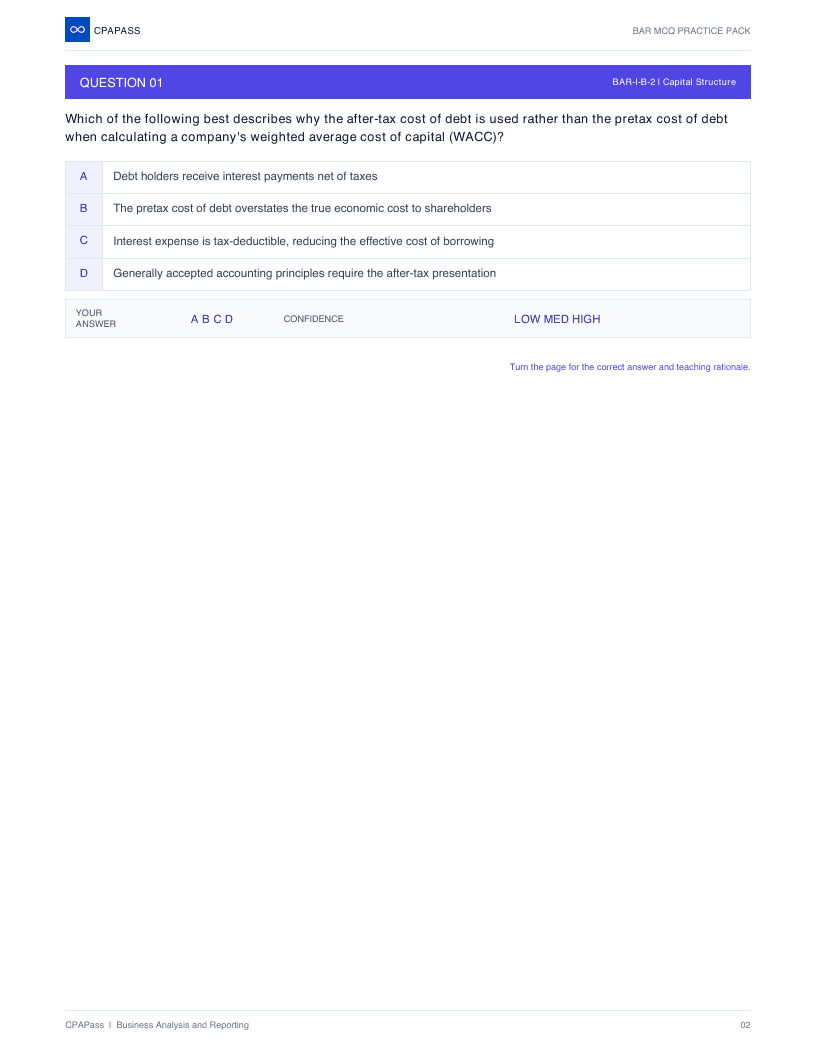
Get six free CPA MCQ practice PDFs in one email, including BAR, ISC, and TCP. Keep the questions handy as you explore your options.
BAR vs ISC vs TCP: direct pairwise answers
BAR vs TCP
Compare reporting and analysis against advanced tax planning. Choose BAR when interpreting financial information and technical reporting creates the smaller learning gap. Choose TCP when multi-step individual and entity tax work is already demonstrably stronger. A FAR or REG pass by itself is not enough evidence.
BAR vs ISC
BAR emphasizes reporting and analytical work, while ISC emphasizes systems, controls, security, data, and IT assurance. Compare one longer applied task from each. If you can calculate a BAR result but cannot explain it, or recognize an ISC term but cannot connect it to a control objective, count that as a real gap.
ISC vs TCP
This comparison is usually clearest when you ignore pass rates and inspect the work. ISC rewards precise control and technology distinctions and uses a 60 percent MCQ weighting. TCP requires applying tax rules across more complex compliance and planning facts. Choose from demonstrated task comfort, not the shorter-sounding syllabus.
Three illustrative candidate decision examples
These CPAPass scenarios demonstrate the decision method. They are not AICPA questions, official candidate profiles, or predictions of an individual result.
- Reporting analyst considering BAR: Priya is comfortable with FAR mechanics and regularly explains financial-statement changes at work. She tries a BAR set and gets the calculation right but misses the written conclusion. Her next step is not to select BAR immediately. She practices two analysis-heavy tasks and checks whether the explanation gap closes.
- IT auditor considering ISC: Daniel recognizes SOC reports, access controls, and security terminology from work. His ISC errors come from two narrowly confused control objectives, while his BAR and TCP samples expose broad unfamiliarity. ISC is the smallest demonstrated learning gap, so he reads the Blueprint and begins a longer ISC diagnostic.
- Tax associate considering TCP: Elena performed well in REG and works with entity compliance, but a TCP planning sample reveals that she applies routine rules without evaluating alternatives. She reviews the missed assumptions before choosing. The high TCP population pass rate does not erase that personal evidence.
Use free samples as a diagnostic, not a prediction
Give each Discipline the same short test: work without notes, review every answer, and label each miss as unfamiliar terminology, missing rule knowledge, calculation error, or weak explanation. Then rate how much new learning the current Blueprint appears to require. A single correct answer is not enough; you are looking for a repeated pattern across content and task style.
| Evidence | Question to record | Do not mistake it for |
|---|---|---|
| Terminology | Could I explain the term before seeing the answer choices? | Recognizing a familiar word |
| Application | Could I choose and defend the rule from the facts? | Getting one calculation right |
| Task comfort | Could I organize exhibits and complete the requested work? | Preferring fewer simulations |
| Learning gap | Were misses narrow and teachable or broad and foundational? | Using the population pass rate |
Three checks before choosing
- Check the current Blueprint. Compare the topic groups, skill levels, and representative tasks for all three Disciplines.
- Check your evidence. Use coursework, work experience, Core performance, and sample question results instead of a preference label alone.
- Check the item mix. ISC is 60 percent MCQ and 40 percent TBS. BAR and TCP are 50/50.
If two Disciplines still look equally good
Separate an unfamiliar term from a weak underlying skill. A term can be learned quickly; a broad content gap usually needs more study time. If two samples feel equally comfortable, try a longer practice set from both sections and compare how well you can explain the answers.
If the result is still tied, compare the representative tasks and item mix rather than the headline pass rate. Choose only when one content family and testing style is the better fit. Your Discipline does not appear as a different license designation, so the decision is about the exam path, not a permanent professional label.
CPA Discipline questions, answered
Which CPA Discipline should I choose?
Choose the Discipline whose tested content and item mix best match your coursework, work experience, and performance on related Core material. Try sample questions from all three before deciding.
Is TCP the easiest CPA Discipline?
TCP had the highest 2026 Q1-Q2 cumulative pass rate, but that is a population result, not an individual probability. Candidate experience and self-selection can affect each Discipline pass rate.
Does my CPA Discipline appear on my license?
No. The selected Discipline does not produce a different CPA license. Every candidate still passes the three Core sections and one Discipline.
Save your Discipline decision
Build your free practice history before you lock in a section
Create a free account to keep BAR, ISC, and TCP results together and continue with personalized drills for the section you select.