Check Kiting: Find Cash Counted Twice
Quick answer
Check kiting can inflate cash by counting funds in two accounts. In a year-end transfer schedule, look for a receipt recorded before year-end with the matching disbursement recorded afterward. Our example overstates cash by $18,400.
Reviewed . Original CPAPass exercises.
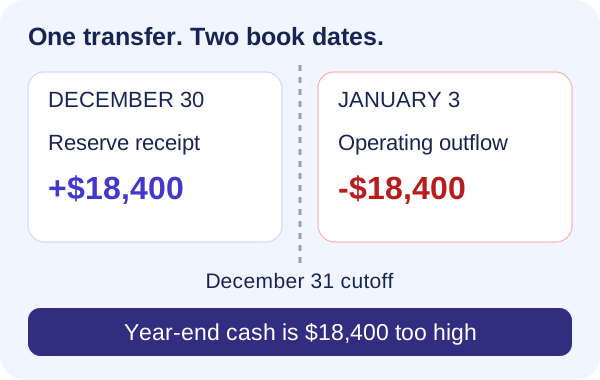
1. Separate the two sets of dates
Books show when the company recorded each side. Bank dates show when each bank processed it. Compare the two book dates first, then corroborate them with bank evidence.
An internal transfer creates no new total cash. A bank-clearing delay alone does not establish a book misstatement or prove fraud.
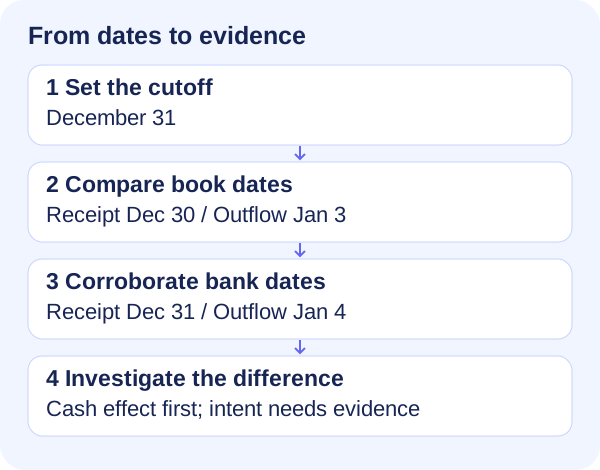
2. Read one transfer across year-end
Larch has a December 31 year-end and two accounts: operating cash $79,000 and reserve cash $47,000 before the transfer. A valid $18,400 transfer occurs December 30. Assume no other transactions, fees or overdrafts.
| Evidence | Disbursement | Receipt |
|---|---|---|
| Company books | January 3 | December 30 |
| Bank records | January 4 | December 31 |
The reserve receipt is in December books, but the operating reduction is postponed until January. At December 31, the books include the receipt without removing the same funds from operating cash.
Quick check: Would January bank clearing alone prove the books are wrong?
Check the bank date
No. If both sides were correctly recorded in December, later clearing could be a normal reconciliation item. Investigate the book dates and supporting evidence together.
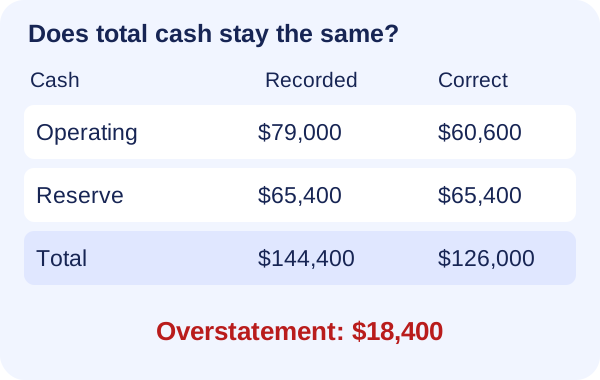
3. Calculate the duplicate cash
Recorded cash is $79,000 + $65,400 = $144,400. Correct cash is $60,600 + $65,400 = $126,000. The difference is an $18,400 overstatement.
The receiving balance already includes $18,400. The missing reduction belongs to the paying account. Do not remove the amount from both accounts or treat the internal receipt as revenue.
4. Follow up on the exception
For this issuer-audit exercise, test the completeness and accuracy of the company’s schedule. Match transfers to both cash journals, supporting documents, bank statements and reconciliations around the reporting date.
Resolve inconsistent evidence and assess other affected transfers. A mismatch can be an error or intentional misstatement; the dates alone do not establish intent.
This lesson isolates cash cutoff. Use the bank-reconciliation lesson for reconciliation mechanics and the transaction-cycle guide for broader assertion and procedure selection.
5. Try a two-transfer check
Two valid internal transfers occurred in December. For $9,200, only the receipt was recorded in December. For $3,400, only the disbursement was recorded in December. With no other errors, what is the net year-end cash misstatement?
- A. $9,200 overstatement
- B. $5,800 overstatement
- C. $12,600 overstatement
- D. No misstatement
Reveal the answer and explanations
B is correct: $5,800 overstatement. The first transfer adds $9,200 too much; the second removes $3,400 too much. Net: $9,200 - $3,400 = $5,800. Investigate both exceptions despite the offset.
- A ignores the understated cash from the second transfer.
- C adds absolute errors instead of their signed effects.
- D assumes an internal transfer can never distort recorded cash.
Check your reasoning
- Mark the cutoff and both book dates.
- Assign a signed cash effect.
- Corroborate the mismatch before concluding.
Common kiting questions
Does every timing mismatch prove kiting?
No. Investigate the facts; an error and intentional fraud are different conclusions.
Why retain bank dates?
They corroborate the transfer and help explain reconciliation differences. They do not replace the company’s recording dates.
Does an internal transfer increase revenue?
No. Moving the company’s own cash between accounts creates no revenue.
Can offsetting errors be ignored?
No. A smaller net amount does not explain either exception or remove the need to investigate.
Related AUD study
- Bank reconciliationReconcile bank and book balances.
- Audit transaction cyclesConnect risks, assertions and procedures.
- AUD study topicsChoose your next AUD topic.
Scope and sources
The 2026 AUD Blueprint connection is an educational inference. ACFE supports the stable kiting concept; PCAOB standards support the issuer-audit response. Nonissuer audits use AICPA standards. Original CPAPass exercises, not AICPA material.