Joint Cost Allocation for BAR: Work the NRV Method
The NRV method
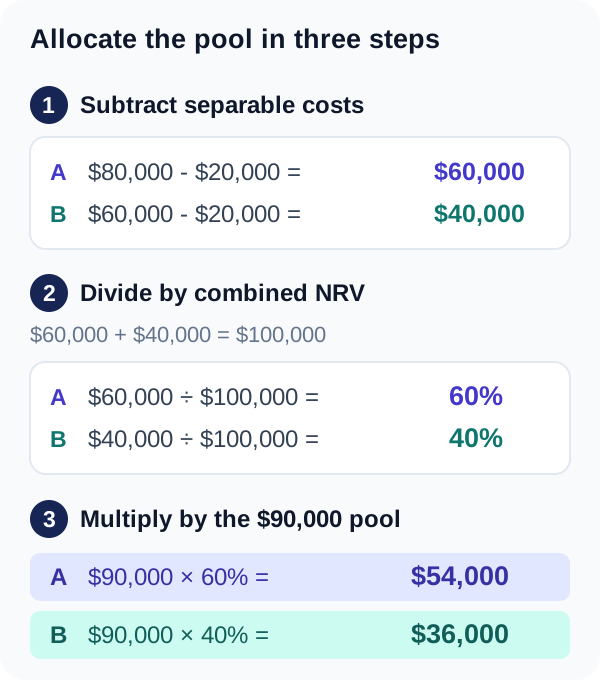
For net realizable value (NRV) allocation, subtract separable costs from each product's final sales value. Divide by combined NRV, then multiply by the joint cost pool. Here, A gets $54,000 and B gets $36,000.
Sources checked . Original teaching exercises, not AICPA exam questions.
1. Identify the allocation method
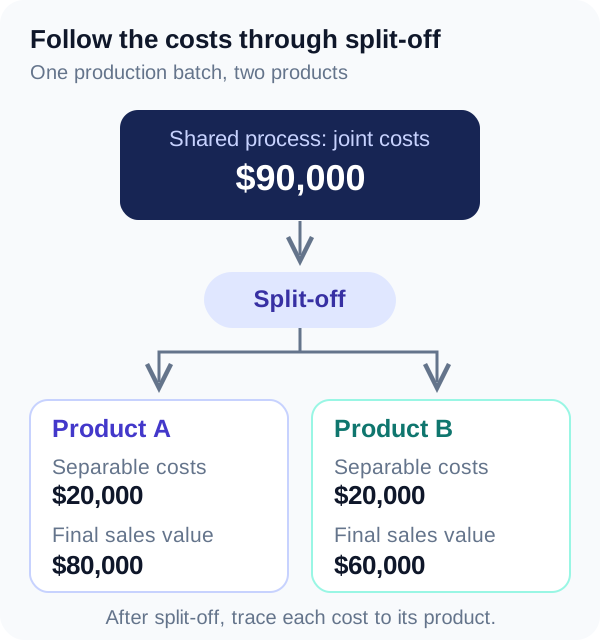
Joint products share a process until split-off, when they become separately identifiable. Shared costs before split-off form the joint pool. Costs traceable to a product afterward are separable.
The requested method determines the base. A physical measure uses comparable output, such as kilograms. Sales value at split-off uses output multiplied by its split-off price. NRV uses final sales value less separable costs. A final selling price is not automatically a price at split-off.
2. Work the example from batch totals
A processor incurs $90,000 of joint costs. Neither product can be sold at split-off. The batch produces 4,000 kg of A, selling for $20 per kg, and 6,000 kg of B, selling for $10 per kg. Use NRV, assuming completed output, no spoilage, and only the separable costs shown.
| Batch information | Product A | Product B |
|---|---|---|
| Output produced | 4,000 kg | 6,000 kg |
| Final selling price per kg | $20 | $10 |
| Final sales value | $80,000 | $60,000 |
| Separable costs | $20,000 | $20,000 |
| NRV allocation base | $60,000 | $40,000 |
| Share of total NRV | 60% | 40% |
| Allocated joint cost | $54,000 | $36,000 |
Combined NRV is $60,000 + $40,000 = $100,000. Product A receives $90,000 × ($60,000 ÷ $100,000) = $54,000. Product B receives $90,000 × ($40,000 ÷ $100,000) = $36,000.
Quick check: What is Product A's total production cost?
Check your total
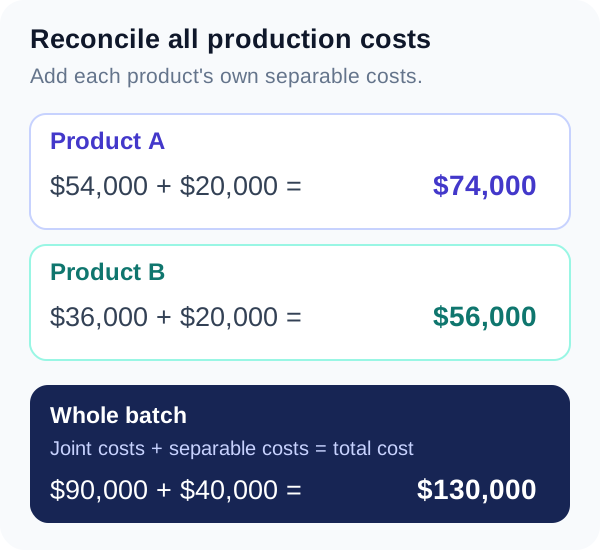
Check the allocation: $54,000 + $36,000 = $90,000, the original pool. For total production cost, add each product's separable costs after allocation. Product A totals $54,000 + $20,000 = $74,000; Product B totals $36,000 + $20,000 = $56,000. Together: $130,000.
3. Diagnose the tempting wrong answers
Product A's answer choices come from different allocation bases or cost totals:
| Answer | What happened |
|---|---|
| $36,000 | 4,000 ÷ 10,000 × $90,000. Physical-output share, not NRV. |
| About $51,429 | $80,000 ÷ $140,000 × $90,000. Final-sales-value share; separable costs were not deducted. |
| $54,000 | $60,000 ÷ $100,000 × $90,000. The requested NRV allocation. |
| $74,000 | $54,000 + $20,000. Total production cost, not allocated joint cost. |
Underline the method and the amount requested. Physical output assigns only 40% of this pool to Product A, while NRV assigns 60%. Using the wrong base and reporting total production cost are different mistakes.
4. Keep the joint cost pool out of the NRV base
The $90,000 pool is the amount being allocated. Deduct each product's separable costs, not the joint pool, when calculating its NRV weight. Subtracting the joint cost again mixes the allocation target into its own weighting calculation.
Allocation alone doesn't tell you whether further processing is worthwhile. That decision compares additional revenue with additional costs; joint costs already incurred don't change between those alternatives.
5. Try a fresh question
Allocate $84,000 of joint costs using NRV. Both products require further processing before sale. Assume no other separable costs.
| Batch totals | Product C | Product D |
|---|---|---|
| Final sales value | $90,000 | $75,000 |
| Separable costs | $30,000 | $15,000 |
How much joint cost goes to Product C?
- A. $30,000
- B. $42,000
- C. About $45,818
- D. $60,000
Reveal the answer and explanation
B. $42,000. Product C's NRV is $90,000 - $30,000 = $60,000. Product D's is $75,000 - $15,000 = $60,000. Each receives half the pool: $42,000 + $42,000 = $84,000.
Option A ($30,000) is Product C's separable cost. Option C (about $45,818) uses final sales value without deducting separable costs. Option D ($60,000) is Product C's NRV base, not its allocated cost.
Use the same three checks each time
- Identify the split-off point and the method requested.
- Subtract separable costs to calculate each NRV weight.
- Apply the weights, then reconcile to the joint pool.
Common NRV questions
Is NRV the allocated joint cost?
No. NRV sets the allocation weight. Apply that weight to the joint pool to find the allocated cost.
Do separable costs belong in the joint pool?
No. Trace separable costs to each product after allocating the shared pool.
Should the NRV weights add to 100%?
Yes. Each product is weighted against the same combined NRV, so the shares exhaust the joint pool.
Does a larger final sales value mean a larger allocation?
Not necessarily. Under NRV, separable costs also affect the weight. Products C and D illustrate equal allocations despite different sales values.
Related BAR study
- Activity-based costingCompare a different approach to assigning production costs.
- BAR section overviewSee the broader Business Analysis and Reporting study scope.
- CPA Exam BlueprintsCheck the official scope and effective blueprint version.
Scope and sources
Joint costing is not separately named in the 2026 AICPA Blueprints. Its connection to BAR managerial and process costing is an educational mapping, not a prediction of exam questions.
Original CPAPass content. AICPA sets exam scope.