Operating Leverage: Turn a Sales Change into an Income Change
Quick answer
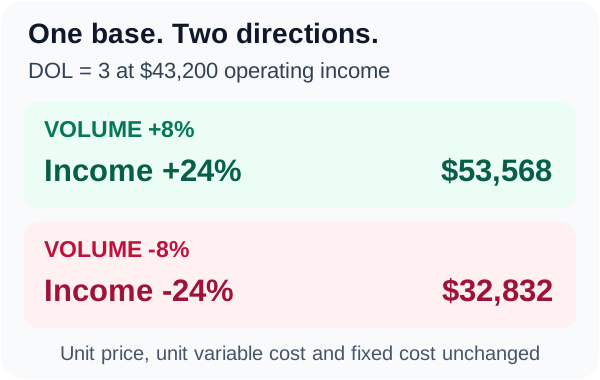
Degree of operating leverage (DOL) = contribution margin ÷ operating income. At a positive base income, multiply DOL by the sales-volume change percentage to find the operating-income change percentage, under constant cost assumptions.
Reviewed . Original CPAPass exercises.
1. Build the right denominator
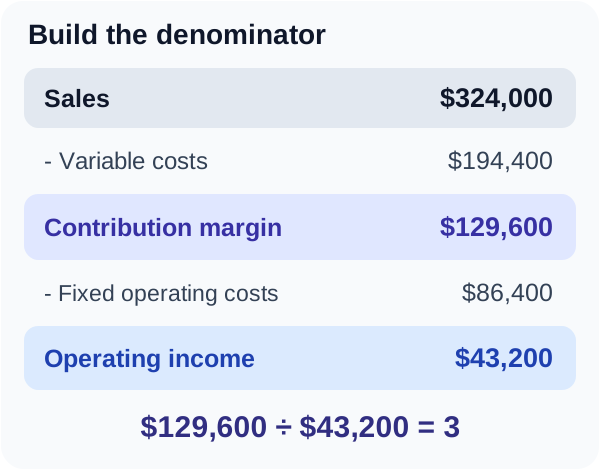
Contribution margin = sales - variable costs. Operating income = contribution margin - fixed operating costs. Use total amounts for the same period.
Assume one product, unchanged unit price and variable cost, and unchanged total fixed cost within the relevant range. Interest and income taxes are outside this operating-income calculation.
2. Worked example: calculate DOL
Harbor Kits sells 7,200 units at $45 each. Variable cost is $27 per unit; fixed operating cost is $86,400.
| Amount | Calculation | Result |
|---|---|---|
| Sales | 7,200 × $45 | $324,000 |
| Variable costs | 7,200 × $27 | $194,400 |
| Contribution margin | Sales - variable costs | $129,600 |
| Fixed costs | Given | $86,400 |
| Operating income | Margin - fixed costs | $43,200 |
DOL = $129,600 ÷ $43,200 = 3. A 1% volume change produces a 3% operating-income change from this base, with the assumptions unchanged.
Quick check: From this base, what happens if sales volume falls 5%?
Check the percentage change
Income falls 15%: 3 × 5%. Remaining income is $43,200 × 85% = $36,720.
3. Verify the sales-change calculation
Sales volume rises 8% to 7,776 units. The multiplier predicts an income increase of 3 × 8% = 24%. Recompute the statement:
| Amount | Base | Volume +8% |
|---|---|---|
| Sales | $324,000 | $349,920 |
| Variable costs | $194,400 | $209,952 |
| Contribution margin | $129,600 | $139,968 |
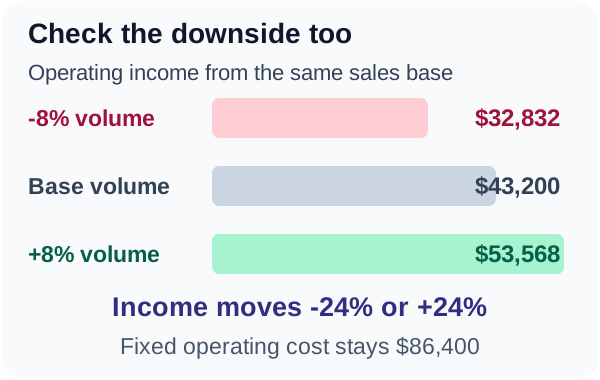
| Fixed costs | $86,400 | $86,400 |
| Operating income | $43,200 | $53,568 |
Income rises $10,368: $53,568 - $43,200. Dividing by the original $43,200 confirms 24%. Fixed cost stays $86,400.
The same base also predicts the downside: an 8% volume decline reduces income 24% to $32,832.
4. Know when to recompute
DOL belongs to a specific sales level. At the higher volume, it becomes $139,968 ÷ $53,568, about 2.61. Do not carry the old multiplier into a new base.
At break-even, income is zero and DOL is undefined. Near zero, the percentage is sensitive to a small denominator. For losses or changed price, costs or mix, calculate income directly.
DOL describes operating sensitivity, not the probability of a sales change. Financial leverage concerns financing costs and is a separate analysis.
5. Try an original BAR-style question
Sales are $280,000, variable costs $168,000 and fixed operating costs $84,000. Sales volume falls 6%; the stated cost assumptions hold. What happens to operating income?
- A. Falls 6% to $26,320
- B. Falls 24% to $21,280
- C. Falls 18% to $22,960
- D. Rises 24% to $34,720
Reveal the answer and explanations
B is correct. Contribution margin is $112,000; income is $28,000; DOL is 4. Income falls 24% to $21,280.
- A applies the 6% sales change directly to income.
- C divides fixed costs by income, giving 3 instead of 4.
- D reverses the direction of the income change.
Check your reasoning
- Calculate contribution margin, then operating income.
- Use DOL from the original sales level.
- Verify the result with a new income statement.
Common operating-leverage questions
Why subtract fixed costs before dividing?
DOL uses operating income as its denominator. Contribution margin still has to cover fixed operating costs.
Can I use after-tax net income in DOL?
Use operating income for this formula. Interest and income taxes introduce different effects.
Does a DOL of 3 mean income will grow 3%?
Only if sales volume grows 1% from that base and the stated assumptions hold. DOL does not predict sales.
Why is DOL undefined at break-even?
Operating income is zero, so the formula would divide by zero.
Related BAR study
- Break-even analysisFind the sales needed to cover costs.
- Sensitivity analysisChange one assumption at a time.
- BAR study topicsChoose your next BAR topic.
Scope and sources
The BAR connection is an educational inference from cost and forecasting tasks in the January 2026 Blueprint. OpenStax (2019) supports the formula. Reviewed September 25, 2026. Calculations and questions are original CPAPass exercises, not AICPA material.