Present Value of an Annuity: Put Each Payment on the Timeline
Quick answer
For equal end-of-period payments, present value = payment × [1 - (1 + r)^(-n)] ÷ r. Use the rate per payment period and the number of payments. If all payments begin one period earlier, multiply that result by (1 + r).
Reviewed . Original CPAPass exercises.
1. Choose the timing before the factor
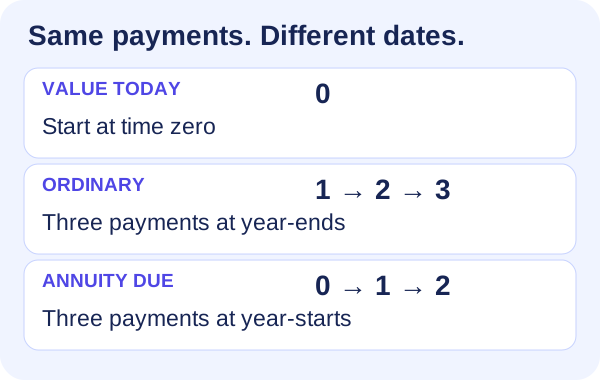
An ordinary annuity starts at time 1; an annuity due starts at time 0. Mark the valuation date before placing payments.
Use this shortcut for equal payments at equal intervals and a constant rate. A separate final lump sum needs its own present-value calculation.
2. Discount three year-end payments
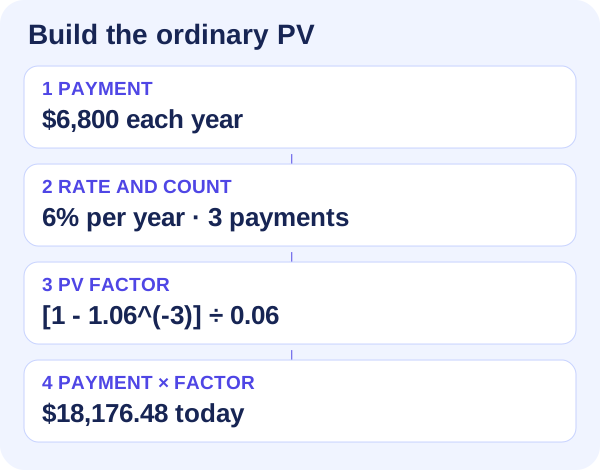
Maple receives $6,800 at each of the next three year-ends. Value the stream today at a supplied 6% effective annual rate. Assume certain payments, no taxes, fees or separate terminal cash flow.
| Year | Discount | PV today |
|---|---|---|
| 1 | $6,800 ÷ 1.06 | $6,415.09 |
| 2 | $6,800 ÷ 1.06² | $6,051.98 |
| 3 | $6,800 ÷ 1.06³ | $5,709.41 |
| Total | Sum unrounded values | $18,176.48 |
The factor is [1 - 1.06^(-3)] ÷ 0.06 = 2.673011949… . Multiply $6,800 by that factor to get $18,176.48. Check the result using individual discounts.
Quick check: Does the third payment get divided by 1.06 or by 1.06 cubed?
Check the discount period
Use 1.06 cubed: it is three periods from today. The first payment is one period away, even though we value the stream at time zero.
3. Move the same payments one period earlier
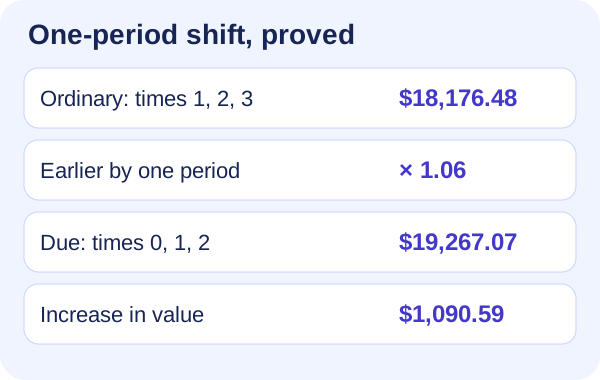
Now place the same three payments at times 0, 1 and 2. This is an annuity due. Multiply the unrounded ordinary PV by 1.06 to obtain $19,267.07.
| Time | Calculation | PV today |
|---|---|---|
| 0 | Immediate payment | $6,800.00 |
| 1 | $6,800 ÷ 1.06 | $6,415.09 |
| 2 | $6,800 ÷ 1.06² | $6,051.98 |
| Total | Sum unrounded values | $19,267.07 |
The first $6,800 is already at today’s value. Add it to the discounted second and third payments; do not discount the immediate payment.
Moving the same three payments earlier increases value $1,090.59. No fourth payment was added. At a positive rate, earlier receipt increases present value.
Keep full precision until rounding the final answer to cents.
4. Check the units and the question
For six semiannual payments over three years, use n = 6 and the supplied half-year rate. If that rate is 3%, enter 0.03, not 0.06. Do not automatically halve an effective annual rate.
A value today needs a PV factor. A single final payment needs a single-sum factor. Unequal payments need individual discounting; forcing them into an annuity formula loses information.
At a zero rate, PV simply equals payment × count. The displayed formula otherwise divides by zero. Our worked examples assume positive rates.
This lesson values a cash-flow stream. Choosing an investment requires the other relevant inflows and outflows; instrument-specific accounting has additional rules.
5. Try an original timing question
A stream pays $4,200 at the beginning of each year for four years, starting today. The supplied effective annual rate is 5%. What is its present value just before the first payment?
- A. $14,892.99
- B. $15,637.64
- C. $16,800.00
- D. $4,200.00
Reveal the answer and explanations
B is correct: $15,637.64. Discount at times 0, 1, 2 and 3, or multiply the four-payment ordinary PV of $14,892.992117… by 1.05.
- A delays every payment one year and values an ordinary annuity.
- C adds the four payments without discounting future amounts.
- D counts only the immediate payment and omits the other three.
Check your reasoning
- Mark time zero and the first payment.
- Match the rate to each payment period.
- Discount each payment to verify the factor.
Common annuity questions
Does an annuity have to be a retirement product?
No. Here it means equal cash flows at equal intervals, used as a calculation model.
Is the first ordinary payment discounted?
Yes. It is one period after the valuation date.
Do I use the due adjustment twice?
No. If the supplied factor already is an annuity-due factor, multiply only by the payment.
Is this the same as net present value?
No. This result values the specified stream. A project decision also incorporates its other relevant cash flows.
Related BAR study
- Capital budgetingCombine relevant cash flows for an investment decision.
- Notes receivableApply instrument-specific measurement and interest accounting.
- BAR study topicsChoose your next BAR topic.
Scope and sources
BAR9 covers present value of future cash flows in the January 2026 Blueprint. This annuity connection is an educational inference. OpenStax supports the mechanics. Reviewed September 29, 2026. Examples and diagrams are original CPAPass work, not AICPA material.