Stock Compensation: Measure Once, Recognize Over Service
Quick answer
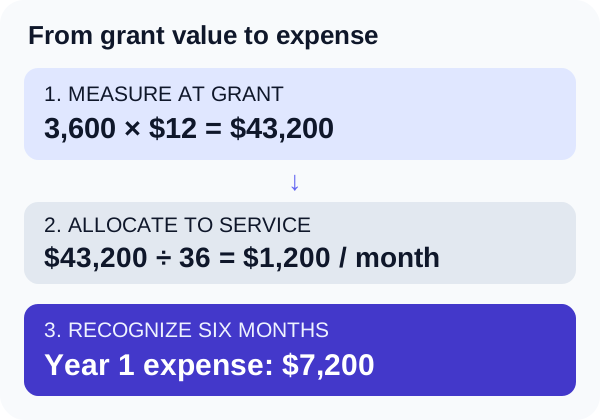
For a service-only employee equity award, allocate the grant-date compensation cost over the requisite service period. In our example, $43,200 spread over 36 months gives $7,200 of expense for the first six months.
Reviewed . Original CPAPass exercises.
1. Separate measurement from recognition
Measurement sets cost; recognition assigns it to periods. For this unchanged equity award, later option values do not replace grant-date fair value.
Cliff vesting occurs all at once, but expense follows service. Here, service starts at grant.
2. Calculate expense from service months
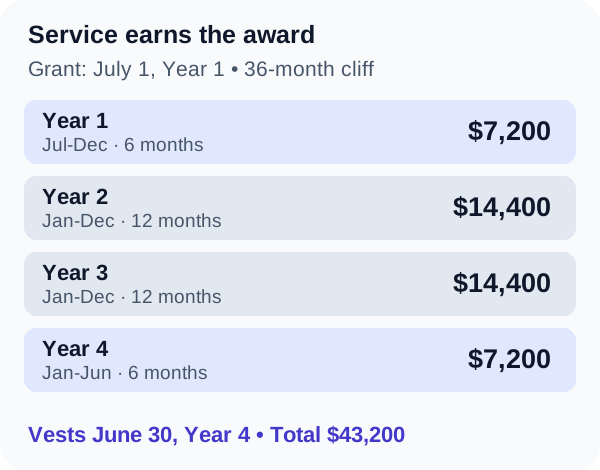
On July 1, Year 1, Vale grants administrative employees the equity options below. They cliff vest June 30, Year 4, after continuous service. All employees remain; assume no modifications, income taxes or capitalizable costs.
| Input | Given amount | Use |
|---|---|---|
| Options granted | 3,600 | Award count |
| Grant-date option fair value | $12 | Cost per option |
| Service period | 36 months | July Year 1 to June Year 4 |
| Year 1 service | 6 months | July through December |
Total cost is 3,600 × $12 = $43,200. Monthly cost is $43,200 ÷ 36 = $1,200. July through December contains six service months, so Year 1 expense is $1,200 × 6 = $7,200.
Quick check: If the option value rises to $16 by December 31, does Year 1 expense become $9,600?
Check the measurement date
No. Keep the $12 grant-date value for this unchanged equity award. The later value does not alter the $7,200 expense.
3. Post the entry and roll forward
At December 31, Year 1: debit Compensation expense $7,200; credit Additional paid-in capital - stock options $7,200. No cash changes hands.
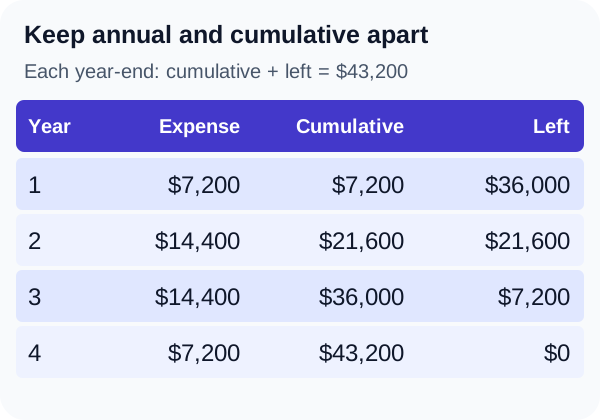
Year 2 expense is $14,400 for 12 months. Check it from cumulative cost: $21,600 less $7,200 already recognized = $14,400.
The four annual amounts below total $43,200. Unrecognized cost reaches zero when service is complete.
4. Keep the inputs in their roles
Use the supplied option fair value, not share price or exercise price. No valuation model is needed here.
An 18-month cumulative amount includes prior-year expense. Subtract it to isolate the latest 12 months.
Liability awards, forfeitures, modifications and different vesting conditions need separate analysis. Exercise and settlement entries are outside this lesson.
5. Try a second-year expense question
On October 1, Year 1, Rowan grants 2,400 employee options, classified as equity, at $15 fair value each. They cliff vest after 24 months of continuous service. All employees remain; terms are unchanged. There are no taxes or capitalizable costs. Year 1 expense was $4,500. At December 31, Year 2, option value is $17. What is Year 2 compensation expense?
- A. $4,500
- B. $18,000
- C. $22,500
- D. $21,000
Reveal the answer and explanations
B is correct: $18,000. Total grant-date cost is $36,000. After 15 months, cumulative cost is $36,000 × 15/24 = $22,500. Subtract $4,500 already recognized to get $18,000 for Year 2.
- A repeats the first three-month expense instead of recognizing the next 12 months.
- C reports cumulative cost, without subtracting the prior-year expense.
- D remeasures at $17: $40,800 × 15/24 - $4,500 = $21,000. That is the wrong measurement basis for this unchanged equity award.
Check your reasoning
- Identify the supplied classification and grant-date fair value.
- Count only the service months in the requested period.
- Subtract prior expense when starting from a cumulative amount.
Common stock compensation questions
Why recognize expense before options vest?
The award is earned through service over 36 months.
Does a rising share price increase this expense?
For this unchanged equity award, retain grant-date option fair value.
Is the exercise price the compensation cost?
No. Option fair value measures the award cost.
Does the first-year entry reduce cash?
No. The credit increases additional paid-in capital.
Related BAR study
- Treasury stock accountingKeep repurchased shares separate from employee compensation.
- Basic and diluted EPSStudy per-share effects as a separate calculation.
- BAR study topicsChoose another BAR topic.
Scope and sources
The January 2026 BAR Blueprint expressly includes equity-award compensation entries using a supplied fair value. This lesson assumes U.S. GAAP employee awards already classified as equity, substantive service-only cliff vesting, and no forfeitures, modifications, capitalization or income taxes. Liability awards, valuation models, graded vesting, performance conditions and tax planning require separate analysis. Original CPAPass exercises; no AICPA authorship or endorsement.