Compensated Absences: Calculate the Vacation Liability
Quick answer
Compensated absences are paid time away from work. Under corporate US GAAP, qualifying leave earned through past service creates a liability before payment. Calculate the required ending balance, then compare it with the amount already recorded.
Reviewed . Original CPAPass exercises.
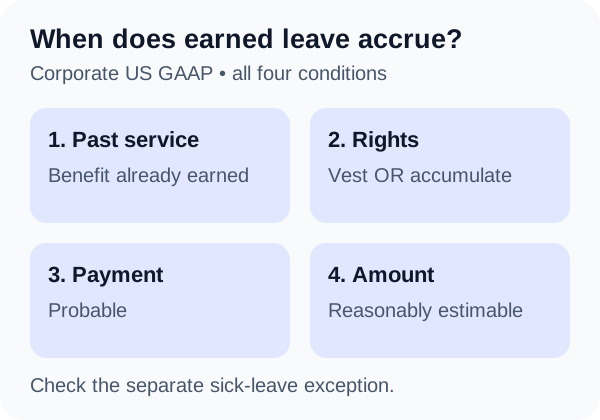
1. Check the leave rights first
Accrue when all four conditions hold: employees have already earned the benefit; rights vest or accumulate; payment is probable; and the amount is reasonably estimable.
Vested means payable even after employment ends. Accumulating means unused rights carry forward. Either can satisfy the rights condition; both are not required.
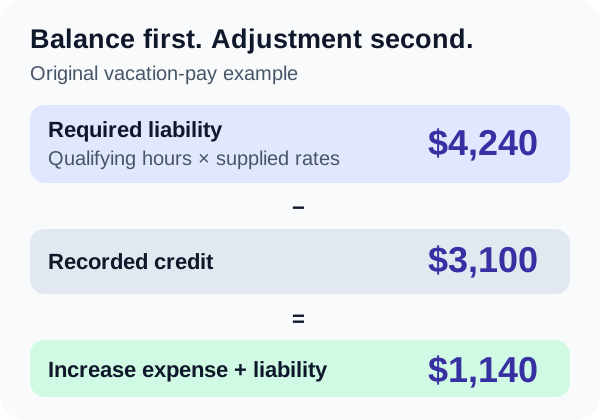
2. Calculate the balance, then the adjustment
Linden’s three employees hold the unused vacation hours below. All recognition conditions are met. Use the supplied current hourly rates; exclude employer taxes, other benefits, forfeitures and pay changes.
| Employee | Unused hours × rate | Liability |
|---|---|---|
| A | 40 × $30 | $1,200 |
| B | 56 × $35 | $1,960 |
| C | 24 × $45 | $1,080 |
| Total | 120 hours | $4,240 |
The required liability is $4,240. Its unadjusted credit balance is $3,100, so debit Vacation Expense and credit Vacation Payable for $1,140. The $3,100 is already part of the liability.
Quick check: with a $4,600 unadjusted credit balance instead, what adjustment reaches $4,240?
Check the adjustment
Debit Vacation Payable and credit Vacation Expense $360. Reduce the excessive accrual.
3. Settle earned leave without expensing it twice
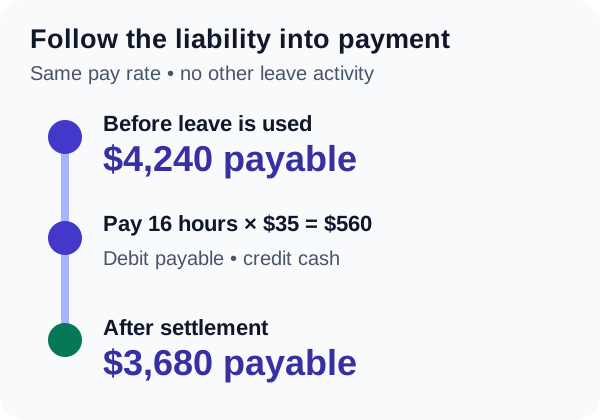
Next period, employee B uses 16 of the accrued hours at the unchanged $35 rate. Assume immediate payment and no other leave activity.
Debit Vacation Payable $560 and credit Cash $560. The remaining liability is $4,240 - $560 = $3,680. No new expense arises for the same benefit already accrued.
A different pay rate or newly earned leave would require a separate calculation. The example deliberately holds those facts constant.
4. Read the sick-leave policy separately
Nonvesting sick leave that accumulates has a specific exception: accrual is permitted but not required when the other recognition conditions hold. Read the stated accounting policy.
Do not apply that exception to vacation automatically. Actual practices also matter: a sick-leave label alone does not establish how the benefit operates.
5. Try an original adjustment question
A company has 180 unused vested vacation hours and 70 nonvesting accumulating sick hours. Pay is $28 per hour. Other recognition conditions hold, but the company elects not to accrue the sick leave. Vacation Payable already has a $5,900 credit. Ignoring taxes and other benefits, what expense adjustment is needed?
- A. $860 debit to expense
- B. $860 credit to expense
- C. $1,100 debit to expense
- D. $5,040 debit to expense
Reveal the answer and explanations
B is correct: credit expense $860. Required Vacation Payable is 180 × $28 = $5,040. Debit the liability $860 to reduce $5,900 to $5,040.
- A reverses the needed direction.
- C includes $1,960 of sick leave despite the stated election.
- D records the full required balance again instead of adjusting it.
Check your reasoning
- Check the leave policy.
- Calculate the required liability.
- Adjust only the difference.
Common compensated-absence questions
Must vacation rights both vest and accumulate?
No. Either can satisfy the rights condition; the other recognition conditions still apply.
Is the ending liability the expense adjustment?
Only if nothing is already recorded. Compare required and recorded balances first.
Must nonvesting accumulating sick leave be accrued?
Not necessarily. The specific exception permits an election when other conditions hold.
Does this cover governmental compensated absences?
No. This lesson applies corporate US GAAP and the supplied vacation-pay assumptions.
Related FAR study
- Accrued payroll entriesHandle unpaid work across a reporting date.
- Accrual accountingReview the broader timing principle.
- FAR study topicsChoose another FAR topic.
Scope and sources
The January 2026 FAR Blueprint explicitly includes accrued vacation in Area II.G. The technical sources explain corporate US GAAP; governmental leave accounting is outside this lesson. Original CPAPass exercises imply no exam frequency, AICPA authorship or endorsement.