Lump Sum Purchase: Allocate Asset Costs for FAR
Quick answer
For a lump sum purchase, also called a basket purchase, allocate the price using relative fair values: asset cost = total purchase price × asset fair value ÷ total fair value. Fair values determine the shares; the price determines the total recorded cost.
Reviewed . Original CPAPass exercises.
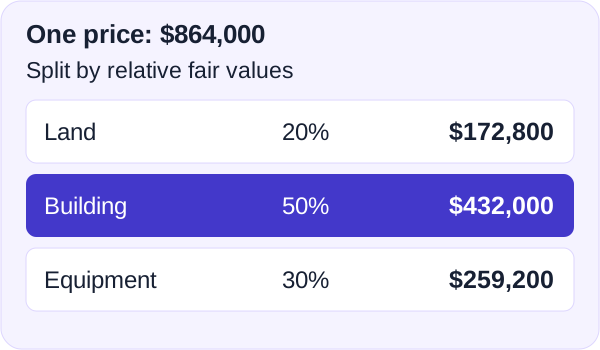
1. Separate the price from the fair values
Alder Works pays $864,000 cash for these three assets together:
| Asset | Fair value |
|---|---|
| Land | $240,000 |
| Building | $600,000 |
| Equipment | $360,000 |
Assume this is a simple asset purchase that does not constitute a business, with no liabilities, other assets, or additional acquisition costs. Business combinations need different accounting.
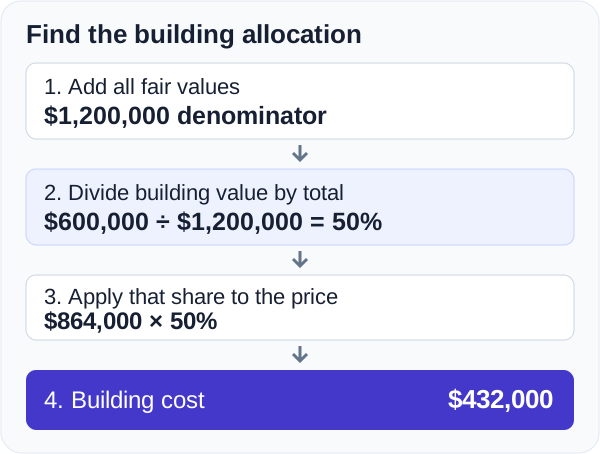
2. Apply each share to the price
First add the fair values: $240,000 + $600,000 + $360,000 = $1,200,000. Use that total as the denominator for every asset. Then multiply each share by $864,000.
| Asset | Share | Cost |
|---|---|---|
| Land | 20% | $172,800 |
| Building | 50% | $432,000 |
| Equipment | 30% | $259,200 |
| Total | 100% | $864,000 |
Quick check: Keep the same fair values, but increase the purchase price to $900,000. What is the land cost?
Check the land allocation
$180,000. Land still represents $240,000 ÷ $1,200,000 = 20% of total fair value. Multiply the new $900,000 price by 20%; changing the price does not change these weights.
3. Record cost, then reconcile the entry
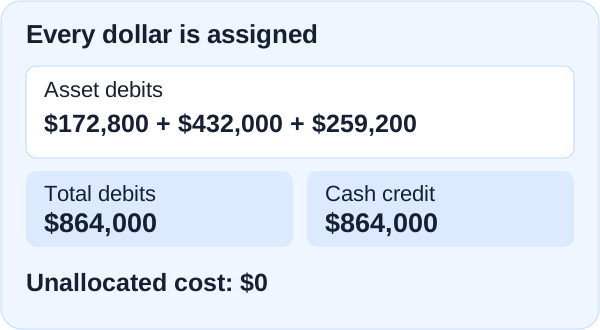
Debit each asset for its allocated cost and credit cash for the price paid. Do not debit the appraisal amounts: they provided the allocation weights.
| Account | Debit | Credit |
|---|---|---|
| Land | $172,800 | - |
| Building | $432,000 | - |
| Equipment | $259,200 | - |
| Cash | - | $864,000 |
The three debits must equal $864,000. No goodwill is recognized in this asset acquisition. The $336,000 gap between total fair value and price is not a separate gain here; the lower price is reflected in the individual asset costs.
4. Avoid three allocation shortcuts
Label the two totals before dividing: total fair value belongs in the denominator; the purchase price is multiplied afterward. Equal splitting works only when the fair values are equal. Keep each fraction or full calculator precision until the final allocation. Rounding a repeating percentage too early can make the allocated costs miss the price.
5. Try an original FAR-style question
A different buyer pays $735,000 for land, a building, and equipment. Their fair values are $350,000, $560,000, and $140,000, respectively. Apply the same simple asset-purchase assumptions. What cost should the buyer record for the building?
- A. $245,000
- B. $392,000
- C. $560,000
- D. $147,000
Reveal the answer and explanations
B. $392,000. Total fair value is $1,050,000. Building cost = $735,000 × ($560,000 ÷ $1,050,000). Keep the fraction unrounded until the final amount.
- A splits the price equally among three assets. Their fair values are unequal.
- C records the building appraisal as cost. Dividing by the price instead of total fair value causes the same error.
- D reuses the earlier 20% land weight. Recalculate the building share from this question.
Check your method
- Add every asset’s fair value.
- Apply each exact share to the price.
- Reconcile allocated costs to cash paid.
Common allocation questions
Why not divide by the purchase price?
The denominator measures each asset’s share of the appraised group. Use total fair value. Apply that share to the price afterward.
Can I split the price equally?
Only equal fair values give equal weights. The worked example requires 20%, 50%, and 30%, not one-third each.
Does this calculate depreciation?
No. This establishes initial asset costs. Subsequent carrying amounts require separate depreciation and other applicable adjustments.
Does a different price change the weights?
Not when the fair values stay the same. The quick check changes land cost to $180,000 while its share stays 20%.
Related FAR study
- Net fixed assetsMove from initial cost to subsequent carrying amounts.
- Depreciation methodsCompare subsequent expense patterns.
- FAR study topicsPlan your wider FAR study.
Scope and sources
FAR13 covers property, plant and equipment balances and journal entries, but does not name basket allocation separately. This FAR connection is an educational inference. These original exercises are not AICPA questions.