Property Dividends: Fair Value, Entries, and Equity
Quick answer
For an ordinary property dividend in this lesson, first adjust the asset to declaration-date fair value and recognize the gain or loss in income. Then debit Retained Earnings and credit Property Dividends Payable at that fair value.
Reviewed . Original CPAPass exercises.
1. Separate the asset adjustment from the dividend
The dividend is an owner distribution, not an expense. The asset gain or loss is a separate income-statement effect.
Assume a lawful, proportionate land distribution with enough retained earnings. Fair value is objectively measurable, realizable in a sale, and unchanged through delivery. Ignore taxes and costs. Exclude spin-offs, reorganizations, liquidation, subsidiary shares and leasebacks.
2. Post the declaration and distribution
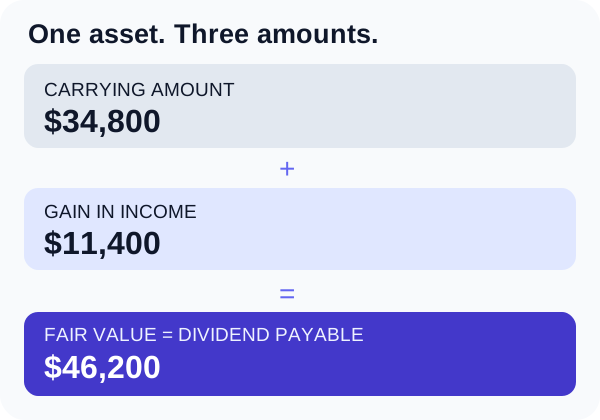
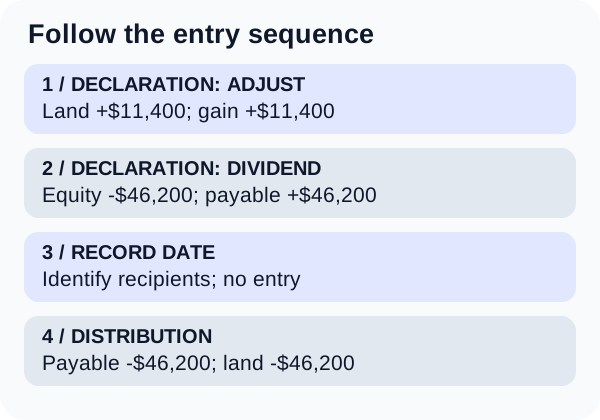
Alder declares a land dividend on June 4. The land carries at $34,800 and has a $46,200 fair value. It is distributed June 20. The gain is $46,200 - $34,800 = $11,400.
| Date / entry | Debit | Credit |
|---|---|---|
| June 4: adjust | Land $11,400 | Gain $11,400 |
| June 4: declare | Retained Earnings $46,200 | Property Dividends Payable $46,200 |
| Record date | No entry | No entry |
| June 20: distribute | Property Dividends Payable $46,200 | Land $46,200 |
The record date identifies recipients and creates no new entry. On June 20, remove the payable and the adjusted land balance; no cash is paid.
Quick check: land carries at $16,300 and is worth $19,600. What are the declaration gain and dividend payable under the same assumptions?
Check the two amounts
$3,300 gain and $19,600 payable. The gain is the difference; the payable is the full fair value.
3. Calculate the total equity effect
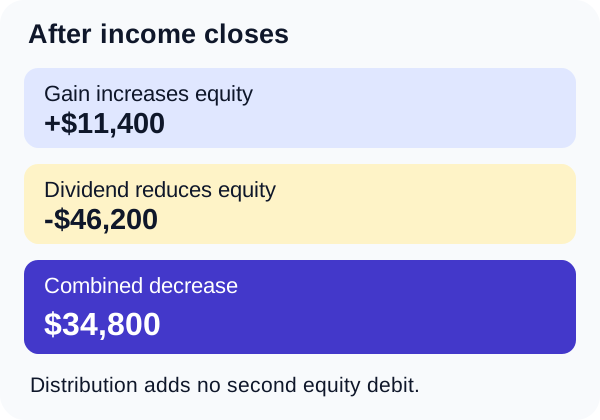
The declaration debits Retained Earnings $46,200. Separately, the $11,400 gain increases net income. After income closes, their combined retained-earnings effect is $11,400 - $46,200 = a $34,800 decrease.
That equals the original carrying amount of the land given up. Distribution itself clears the payable and asset without a second retained-earnings debit.
The reconciliation assumes no other income, dividends or equity changes. It does not mean the dividend entry should use carrying amount.
4. Handle a loss without double counting
When fair value is lower, debit a loss and credit Land for the difference. The dividend still uses fair value under the stated assumptions.
A loss reduces income, while the dividend separately reduces retained earnings. Add those reductions when asked for the total effect after closing income.
Read the requested amount carefully: dividend declared, gain or loss, payable, and total equity change can all differ.
5. Try an original FAR-style question
Under the same assumptions, Birch distributes land carrying at $28,700 with a $24,900 fair value. After closing the resulting gain or loss, what is the combined decrease in retained earnings?
- A. $24,900 decrease
- B. $28,700 decrease
- C. $3,800 decrease
- D. $32,500 decrease
Reveal the answer and explanations
B is correct. The $3,800 loss plus the $24,900 dividend produces a $28,700 decrease.
- A counts only the dividend.
- C counts only the loss.
- D adds the loss to carrying amount, counting it twice.
Check your reasoning
- Find fair value minus carrying amount.
- Record the dividend at fair value.
- Combine the income and dividend effects.
Common property dividend questions
Is the payable the gain?
No. Here the payable is $46,200; the gain is only $11,400.
Does distribution debit retained earnings again?
No. It settles the existing payable with the asset.
Does the record date create an entry?
No. It identifies recipients without changing account balances.
Can I use this for every noncash distribution?
No. These examples exclude business distributions and other special transactions, and assume unchanged fair value.
Related FAR study
- Cash dividend entriesReview the cash-payment sequence.
- Changes in equityConnect equity movements to the statement.
- FAR study topicsChoose another FAR topic.
Scope and sources
The January 2026 FAR Blueprint covers dividends payable and equity entries. This property-dividend application is an educational inference. OpenStax explains the entries; the FFIEC bank glossary corroborates declaration-date measurement. Original exercises do not imply exam frequency, AICPA authorship or endorsement.