Purchase Commitment Loss: Before the Goods Arrive
Quick answer
A purchase commitment loss can arise before inventory arrives. For the noncancelable, unhedged FIFO contract below, recognize the excess of contract cost over net realizable value (NRV): debit Loss and credit a commitment liability. Do not record the undelivered inventory.
Reviewed . Original CPAPass exercises.
1. Identify what has been committed
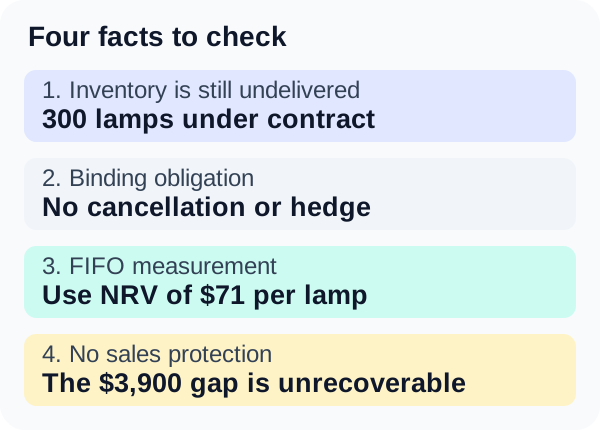
Cedar Supply commits to 300 lamps at $84 each, delivered in February. At signing there is no impairment, deposit or delivery, so the ordinary executory agreement creates no inventory or payable entry. Evaluate commitment disclosures separately.
At December 31, NRV is $71 per lamp. Assume FIFO, a perpetual system, no cancellation right, no hedge and no protective sales contract. All 300 units remain undelivered.
NRV is supplied after completion, disposal and transportation costs. Use it for this FIFO example; a cheaper replacement quote alone is not the same measurement. LIFO and retail inventory use the separate cost-or-market model.
2. Calculate the year-end loss
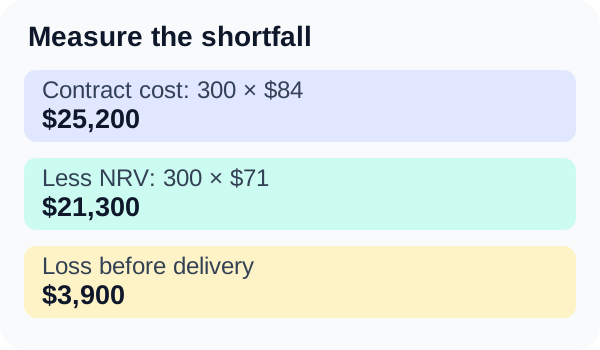
Contract cost is 300 × $84 = $25,200. Recoverable inventory value is 300 × $71 = $21,300. The $13 shortfall per lamp produces a $3,900 loss.
Check it in both directions: $25,200 - $21,300 = $3,900, and $21,300 + $3,900 = $25,200. The contract total includes recoverable value; it is not all a loss.
Quick check: In a separate contract with the same quantity and price, NRV is $88 at year-end and no loss was previously recorded. What loss is required?
Check the loss amount
$0. NRV totals $26,400, above the $25,200 cost. The $1,200 excess is not a gain to book. This separate scenario does not reverse the original $3,900 loss.
3. Recognize the loss before delivery
For the original $71 NRV, record this December 31 entry:
| Account | Debit | Credit |
|---|---|---|
| Loss on Purchase Commitment | $3,900 | - |
| Commitment Liability | - | $3,900 |
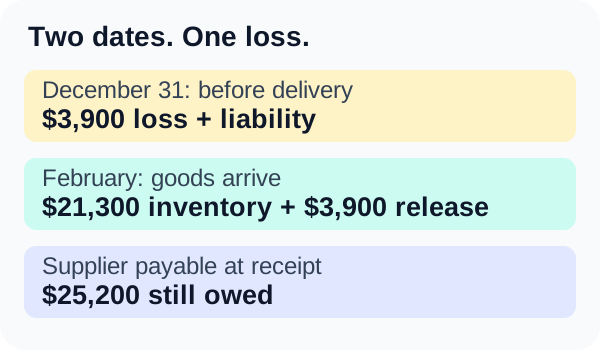
The debit reduces current earnings; the credit records the expected shortfall on the binding contract. It is a loss liability, not the full supplier payable. Inventory remains unrecorded because delivery has not occurred.
Label each balance: $3,900 loss liability now; $25,200 payable on receipt. Crediting both now would overstate obligations.
4. Clear the liability when the goods arrive
In February, all lamps arrive on credit and NRV is still $71. Record inventory and release the loss liability:
| Account | Debit | Credit |
|---|---|---|
| Inventory | $21,300 | - |
| Commitment Liability | $3,900 | - |
| Accounts Payable | - | $25,200 |
Debits total $25,200, matching the payable. The $3,900 liability is now zero. Do not charge the same loss again: it already reduced December earnings.
The $21,300 inventory carrying amount does not change the $25,200 invoice. Changed valuations require a fresh analysis.
5. Try an original FAR-style question
A firm, noncancelable, unhedged FIFO contract covers 240 units at $65. All remain undelivered at year-end; NRV is $58. There is no protective sales agreement, deposit or prior loss. Which entry is required?
- A. $1,680 loss and commitment liability
- B. $15,600 loss and accounts payable
- C. $13,920 loss and commitment liability
- D. No loss until delivery
Reveal the answer and explanations
A. Debit Loss and credit the commitment liability $1,680: 240 × ($65 - $58). Cost $15,600 minus NRV $13,920 gives the same answer.
- B mistakes the full contract cost for the loss and records a supplier payable before receipt.
- C treats the recoverable $13,920 as the loss. Only the $1,680 shortfall is unrecoverable.
- D delays a loss already required at year-end. Delivery is not its recognition trigger.
Check your method
- Confirm the contract and measurement model.
- Separate recoverable value from the loss.
- Release the liability at receipt.
Common commitment questions
Is signing the contract a purchase entry?
Not for this unimpaired executory contract with no deposit or delivery. Assess disclosure separately.
Does any lower quote create a FIFO loss?
No. Assess recovery using NRV, including any protective sales arrangements; do not substitute a replacement quote.
Why is the invoice larger than inventory?
The $25,200 invoice includes the $3,900 loss already recognized, leaving $21,300 inventory in this example.
Is this the general contingency rule?
This lesson applies inventory commitment guidance under ASC 330. General loss contingencies have a separate recognition model.
Related FAR study
- Inventory valuationValue inventory already on hand.
- Loss contingenciesApply the general contingency model.
- FAR study topicsPlan your wider FAR study.
Scope and sources
FAR16 names commitments; this exercise is an educational inference. Blueprint effective January 2026. KPMG: October 2025; Deloitte: December 2022; entry tutorial: January 2020; AccountingTools: July 2026. Reviewed September 18, 2026. Original exercises, not AICPA questions. No cancellation, hedging or recovery accounting covered.