Purchase Discounts: Follow the Invoice to Payment
Quick answer
Purchase discounts reward early payment. The gross method starts with the full invoice; the net method starts after the anticipated discount. If the discount is missed under the net method, record a separate expense.
Reviewed . Original CPAPass exercises.
1. Read the terms and choose the system
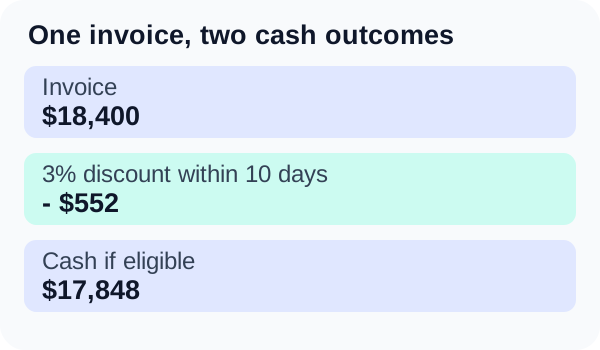
Harbor Stationery buys $18,400 of goods on September 3, terms 3/10, n/30: a 3% discount within 10 days; otherwise the full invoice is due within 30 days.
Assume periodic inventory, no freight, tax, returns, allowances or partial payments. Compare two alternative methods and payment dates. Every entry is from the buyer’s side.
2. Record the purchase, then check the discount
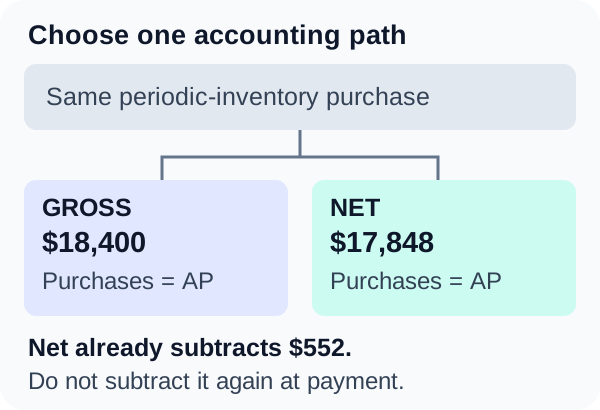
Discount = $18,400 × 3% = $552. Net amount = $18,400 - $552 = $17,848. The purchase entries below are alternatives:
| Method / account | Debit | Credit |
|---|---|---|
| Gross: Purchases | $18,400 | - |
| Gross: Accounts Payable | - | $18,400 |
| Net: Purchases | $17,848 | - |
| Net: Accounts Payable | - | $17,848 |
AP means Accounts Payable. Under periodic inventory, debit Purchases, not Inventory. The net method already includes the expected saving; do not deduct it again on payment.
Quick check: A separate $7,250 invoice offers 2/10, n/30. What cash settles it within the discount window?
Check the cash payment
$7,105. The discount is $7,250 × 2% = $145. Subtract $145 once from $7,250.
3. Pay within the discount window
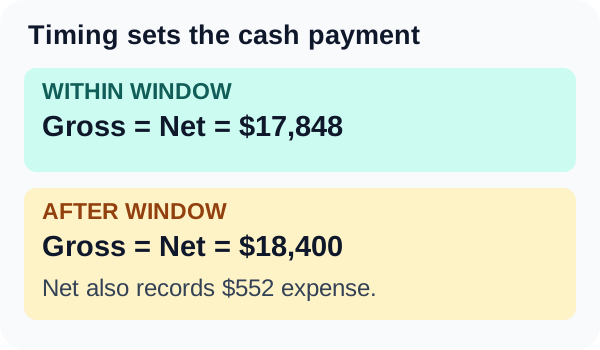
Harbor pays on September 10, within the stated window. Both methods pay $17,848:
| Method / account | Debit | Credit |
|---|---|---|
| Gross: Accounts Payable | $18,400 | - |
| Gross: Cash | - | $17,848 |
| Gross: Purchase Discounts | - | $552 |
| Net: Accounts Payable | $17,848 | - |
| Net: Cash | - | $17,848 |
The gross method needs a separate $552 credit to Purchase Discounts. The net method needs no discount entry because AP was already $17,848. Each payment clears its method’s entire payable.
Purchase Discounts reduces periodic net purchases. It is not the seller’s Sales Discounts account.
4. Miss the discount, not the due date
Instead, suppose Harbor pays on September 24. The discount has expired, but payment is still within 30 days. Cash paid is $18,400:
| Method / account | Debit | Credit |
|---|---|---|
| Gross: Accounts Payable | $18,400 | - |
| Gross: Cash | - | $18,400 |
| Net: Accounts Payable | $17,848 | - |
| Net: Purchase Discounts Lost | $552 | - |
| Net: Cash | - | $18,400 |
Under the net method, $17,848 AP plus $552 Discounts Lost equals $18,400 cash. The lost discount is an expense, not a further reduction of purchases.
The method changes where the $552 appears, not the supplier’s settlement terms. These entries are alternatives to September 10, not another payment.
5. Try an original FAR-style question
A buyer records a $12,600 periodic-inventory purchase using the net method, terms 2/10, n/30. It pays on day 22 with no other adjustments or intervening entries. Which payment entry is correct?
- A. Debit AP $12,348 and Discounts Lost $252; credit Cash $12,600
- B. Debit AP $12,600; credit Cash $12,600
- C. Debit AP $12,348; credit Cash $12,348
- D. Debit AP $12,600; credit Cash $12,348 and Purchase Discounts $252
Reveal the answer and explanations
A is correct. AP was $12,600 - $252 = $12,348. Debit that balance and the $252 lost-discount expense; credit the full $12,600 cash paid.
- B debits AP $252 too much and omits the expense.
- C pays the discounted amount after eligibility ended.
- D treats an expired net-method discount like a timely gross-method discount.
Check your entry
- Identify method and inventory system.
- Check payment timing.
- Clear AP and balance the entry.
Common discount questions
Is Purchase Discounts Lost a credit?
No. In the net-method example it is a debit expense. Purchase Discounts under the periodic gross method is a credit reducing purchases.
What changes under perpetual inventory?
Use Inventory instead of Purchases. A taken gross-method discount reduces Inventory, rather than using the periodic Purchase Discounts account.
Does n/30 mean a second discount?
No. It states the full invoice’s payment deadline. The discount percentage and shorter window are the separate 3/10 terms.
Do these examples include returns or freight?
No. Recalculate the eligible invoice balance when a question supplies adjustments; do not blindly discount every amount due.
Related FAR study
- Freight-in vs. freight-outClassify shipping costs separately.
- FAR journal entriesReview the broader entry workflow.
- FAR study topicsChoose your next FAR topic.
Scope and sources
The FAR payables connection is an educational inference from the January 2026 Blueprint. Textbook sources: Walther (undated) and OpenStax (2019). Reviewed September 20, 2026. Original exercises, not AICPA questions. Reporting-date expiration adjustments and financing-rate calculations are outside this example.