Reversing Entries: Keep Each Period’s Expense Right
Quick answer
Reversing entries swap a selected accrual’s debits and credits at the start of the next period. They are optional. A correct reversal and later payment produce the same period expense as a correctly split payment without reversal.
Reviewed . Original CPAPass exercises.
1. Keep the expense in the period that used it
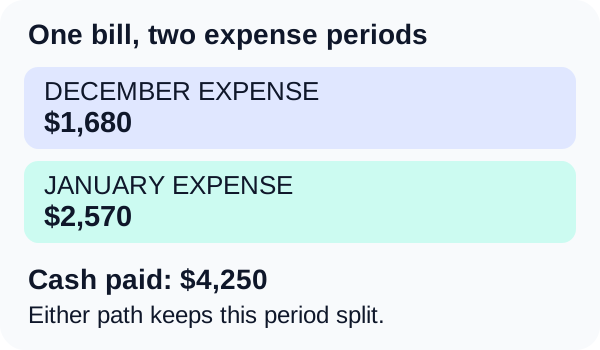
Cedar Studio owes $1,680 for December utilities at December 31. On January 10 it pays $4,250: that December amount plus $2,570 for January usage.
Assume the utility costs are known, fully paid on January 10, and unrecorded before the December adjustment. Ignore taxes, discounts and other entries. Compare alternative paths, not cumulative entries.
2. Record the December accrual first
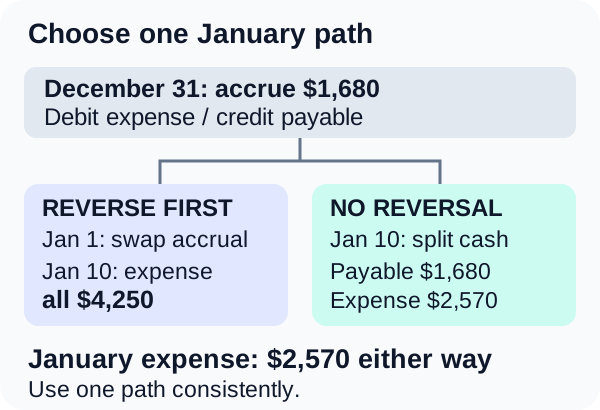
Both paths begin with the same December 31 adjustment. No cash moves on that date:
| Method / account | Debit | Credit |
|---|---|---|
| Utilities Expense | $1,680 | - |
| Utilities Payable | - | $1,680 |
December expense is $1,680 and the year-end payable is $1,680. A January reversal does not rewrite the December financial statements.
Quick check: A separate $2,500 payment covers a $960 prior-period accrual and current usage. Without reversal, how much goes to current expense?
Check the current expense
$1,540. Debit the $960 payable and $1,540 expense; credit Cash $2,500. The prior-period portion must not become current expense again.
3. Reverse once, then record the full payment
If Cedar elects reversal, swap the December entry on January 1. The January 10 payment can then debit the full bill to Utilities Expense:
| Method / account | Debit | Credit |
|---|---|---|
| Jan 1: Utilities Payable | $1,680 | - |
| Jan 1: Utilities Expense | - | $1,680 |
| Jan 10: Utilities Expense | $4,250 | - |
| Jan 10: Cash | - | $4,250 |
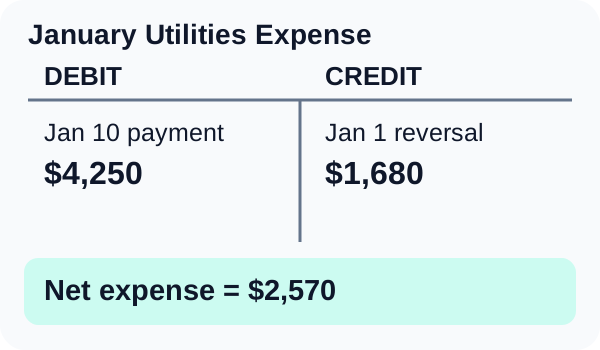
The temporary $1,680 expense credit offsets part of the later $4,250 debit. January net expense is $4,250 - $1,680 = $2,570.
Clearing the bookkeeping payable on January 1 does not cancel the bill or pay the supplier. The reversal contains no Cash entry.
4. Without reversal, split the payment
Alternatively, make no January 1 entry. On January 10, clear the existing payable and expense only January’s portion:
| Method / account | Debit | Credit |
|---|---|---|
| Utilities Payable | $1,680 | - |
| Utilities Expense | $2,570 | - |
| Cash | - | $4,250 |
Either completed path leaves $2,570 January expense, no payable for this bill, and $4,250 cash paid. Use one path consistently.
Do not reverse and then use the no-reversal split: that debits the payable twice. Do not skip reversal and expense the entire bill: that counts December’s $1,680 again.
5. Try an original FAR-style question
A business accrues $1,350 maintenance expense at December 31 and reverses it on January 1. It pays $3,900 on January 16, including that accrual and January service, debiting the full payment to Maintenance Expense. What is January’s net expense?
- A. $2,550 expense
- B. $3,900 expense
- C. $5,250 expense
- D. $1,350 expense
Reveal the answer and explanations
A is correct: $3,900 debit - $1,350 reversal credit = $2,550 January expense. The $1,350 belongs to December.
- B ignores the reversal credit.
- C adds the credit instead of subtracting it.
- D uses the prior-period amount as January expense.
Check your reasoning
- Label the period for each expense.
- Identify whether reversal happened.
- Net the current-period debits and credits.
Common reversing-entry questions
Are reversing entries required?
No. They simplify selected next-period entries. Without reversal, split the later payment correctly between the prior liability and new expense.
Does reversal erase the prior-period expense?
No. The accrual belongs to December; the reversal is dated in January. Review each period separately.
Should every adjusting entry be reversed?
No. This example reverses a selected expense accrual. It is not a rule to undo depreciation, impairments or every other adjustment.
Is a reversing entry the same as a closing entry?
No. Closing resets temporary accounts at period end. Reversal swaps a selected adjusting entry in the following period to simplify later processing.
Related FAR study
- Accrued payrollCalculate compensation earned before closing.
- FAR journal entriesReview the broader entry workflow.
- FAR study topicsChoose your next FAR topic.
Scope and sources
The FAR connection is an educational inference from accrued-liability tasks in the January 2026 Blueprint. Textbook sources: Walther (undated) and OpenStax (2019). Reviewed September 21, 2026. Original CPAPass exercises, not AICPA questions. This lesson covers a selected expense accrual; deferral methods and software settings are outside scope.