Stock Subscriptions: From Agreement to Issued Shares
Quick answer
Stock subscription accounting tracks an agreement to buy shares before full payment. For the equity-classified arrangement here, record subscribed capital and the amount owed, reduce that receivable as cash arrives, then transfer subscribed capital to Common Stock when the shares are issued.
Reviewed . Original CPAPass exercises.
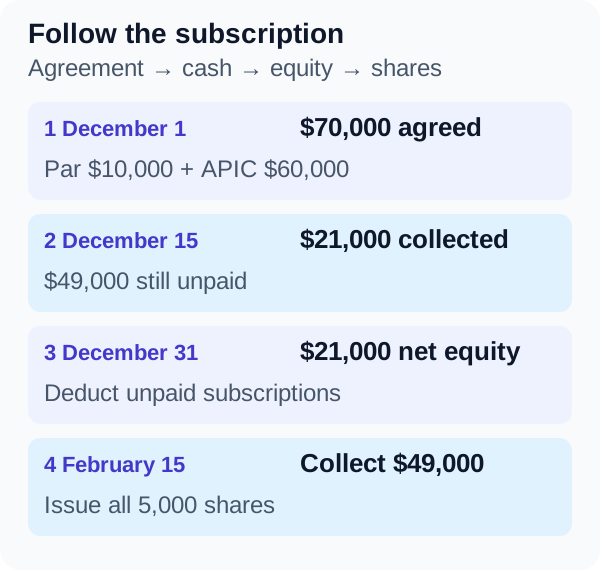
1. Separate the agreement from issued stock
Assume an enforceable agreement with an unrelated investor: fixed shares for fixed cash, no financing component, compensation, issuance costs or default. The contract qualifies for equity treatment; shares issue only after full payment.
Common Stock Subscribed tracks the par amount promised. APIC tracks the excess over par. Neither a cash installment nor the later transfer to issued stock creates sales revenue.
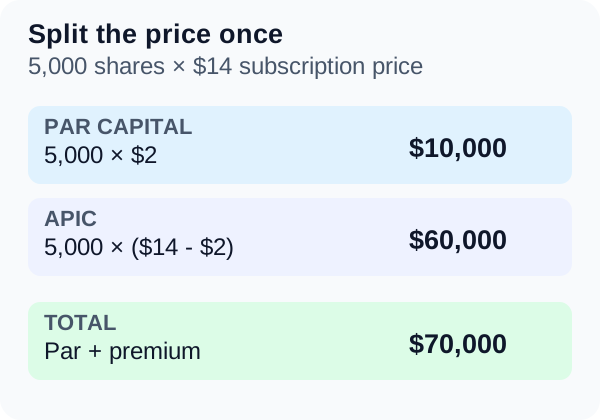
2. Worked example: split the subscription price
On December 1, Alder accepts a subscription for 5,000 shares at $14 each, with $2 par value. The investor pays $21,000 on December 15.
| Component | Calculation | Amount |
|---|---|---|
| Subscription | 5,000 × $14 | $70,000 |
| Par capital | 5,000 × $2 | $10,000 |
| APIC | 5,000 × ($14 - $2) | $60,000 |
| Unpaid | $70,000 - $21,000 | $49,000 |
At agreement: debit Subscriptions Receivable $70,000; credit Common Stock Subscribed $10,000 and APIC $60,000. On collection: debit Cash $21,000 and credit Subscriptions Receivable $21,000.
Quick check: if another $7,000 arrives before year-end, what is the remaining receivable? Does APIC change?
Check the receivable
The receivable becomes $42,000. APIC stays $60,000; collecting cash does not repeat the original premium.
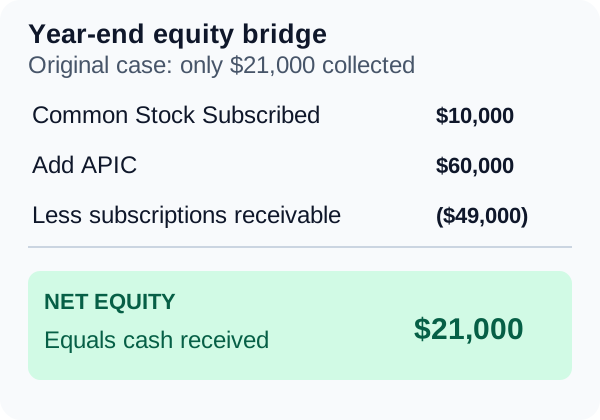
3. Calculate net equity at year-end
Return to the original $21,000 collection. At December 31, $49,000 remains unpaid. Assume Alder follows Regulation S-X presentation and the balance remains unpaid when its statements are issued on January 31.
Show the subscribed capital and APIC, then deduct the $49,000 subscription receivable. Net equity from this arrangement is $10,000 + $60,000 - $49,000 = $21,000.
Do not put this unpaid subscription into ordinary trade receivables. Different collection timing or contract terms can require a separate presentation analysis.
4. Collect the rest and issue the shares
On February 15, Alder receives the remaining $49,000: debit Cash and credit Subscriptions Receivable $49,000. Then debit Common Stock Subscribed and credit Common Stock $10,000 when the shares are issued.
APIC remains $60,000. Net equity from the arrangement is now $70,000. The $10,000 transfer changes the equity caption, not total equity.
5. Try an original equity question
Use the same assumptions and presentation rule. A company accepts 2,400 shares at $18 each, with $3 par. It collects $16,200; the rest remains unpaid through statement issuance, and no shares have issued. What net equity arises from this subscription?
- A. $43,200
- B. $16,200
- C. $7,200
- D. $36,000
Reveal the answer and explanations
B is correct: $16,200. Subscribed capital is $7,200 and APIC is $36,000. Deduct the $27,000 unpaid balance from their $43,200 total.
- A ignores the unpaid subscription deduction.
- C includes only par and ignores APIC and the deduction.
- D mistakes APIC alone for net equity.
Check your reasoning
- Split par and premium.
- Track cash and the unpaid balance.
- Separate collection from issuance.
Common stock-subscription questions
Is Common Stock Subscribed issued stock?
Not in this agreement. The shares issue only after full payment.
Does the final payment create more APIC?
No. The premium was recorded with the subscription; collection settles the receivable.
Is a subscription receivable always an asset?
No. The presentation here deducts it from equity. Other facts require separate analysis.
Does this cover employee stock compensation?
No. Compensation arrangements have separate recognition and classification guidance.
Related FAR study
- Statement of changes in equityReconcile the wider equity rollforward.
- Treasury stock accountingSeparate repurchases from subscriptions.
- FAR study topicsChoose another FAR topic.
Scope and sources
The January 2026 FAR Blueprint includes equity-issuance entries. Its application to subscriptions is an educational inference. This simplified equity-classified case excludes compensation, EPS, defaults and complex contract classification. Original CPAPass exercises imply no exam frequency, AICPA authorship or endorsement.