Weighted Average Inventory Method: One Cost per Unit
Quick answer
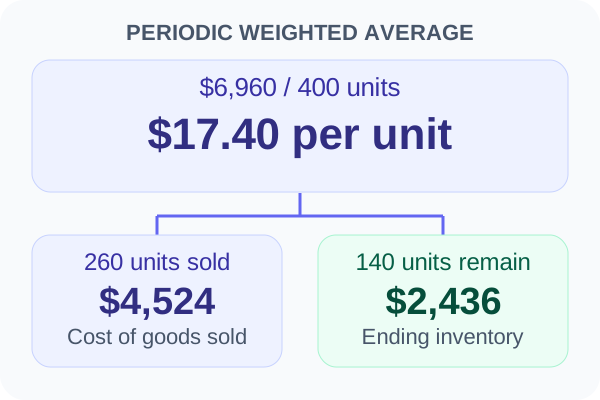
For periodic weighted average, divide the cost of all goods available for sale by their units. Use that same rate for units sold and units remaining. Here, $6,960 divided by 400 units is $17.40 per unit.
Reviewed . Original CPAPass exercises.
1. Start with a period-wide cost pool
Harbor Desk Supply sells one interchangeable notebook model. It starts April with 80 units costing $14 each, then buys 120 at $17 and 200 at $19. It sells 260 units; the verified ending count is 140.
Assume periodic inventory, all stated purchases received during April, and complete inventory costs. There are no returns, discounts, shortages, additional costs or write-downs. These are merchandise units, not partly completed production.
2. Weight the prices by units
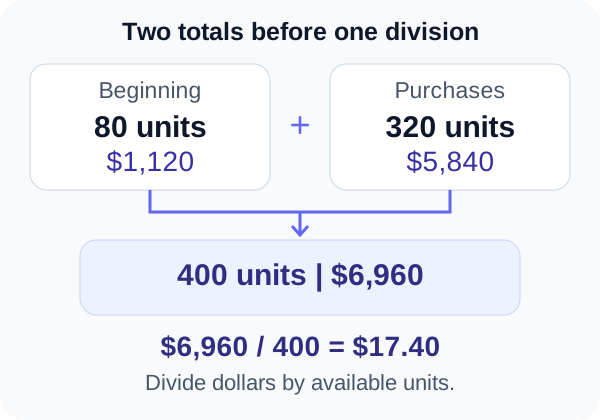
Build the cost pool before dividing:
| Source | Units | Unit cost | Total cost |
|---|---|---|---|
| Beginning inventory | 80 | $14.00 | $1,120 |
| First purchase | 120 | $17.00 | $2,040 |
| Second purchase | 200 | $19.00 | $3,800 |
| Available | 400 | - | $6,960 |
$6,960 / 400 = $17.40 per unit. Include beginning inventory in both totals. Dividing the three prices by three gives about $16.67 and ignores the unequal quantities.
Quick check: A separate pool contains 120 units costing $1,920. Thirty units remain. What is the weighted-average cost per unit?
Check the unit cost
$16: divide $1,920 by all 120 available units, not the 30 remaining. Ending inventory is $480; the 90 sold units cost $1,440.
3. Assign the same rate to both destinations
Multiply the $17.40 rate by each unit count:
| Destination | Units | Rate | Cost |
|---|---|---|---|
| Cost of goods sold | 260 | $17.40 | $4,524 |
| Ending inventory | 140 | $17.40 | $2,436 |
| Total assigned | 400 | - | $6,960 |
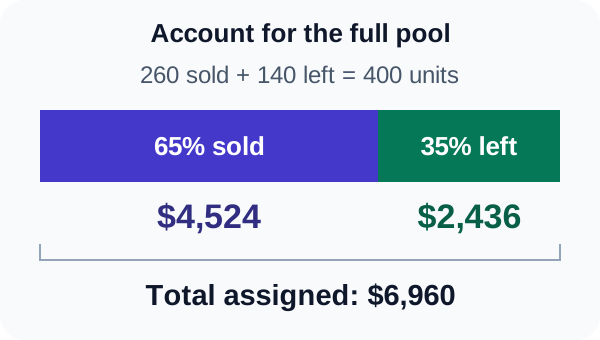
The 140 units still owned carry $2,436 of cost into the balance sheet. The 260 sold units carry $4,524 into cost of goods sold. Neither calculation uses the customer selling price.
Check quantities and dollars separately. All 400 units and all $6,960 must be accounted for once.
4. Check the system before reusing the formula
This periodic calculation pools the entire month. A perpetual moving-average exercise instead updates the running average when a purchase arrives; the rate available at each sale matters.
Do not assume the two systems give the same result when purchases and sales are interleaved. First read which system the question specifies.
Keep unrounded averages in your working and round final amounts as instructed. This example has an exact $17.40 rate, so $4,524 + $2,436 reconciles without a rounding adjustment.
5. Try an original FAR-style question
A retailer uses periodic weighted average. Beginning inventory is 60 units at $12; it buys 140 units at $15. Fifty units remain after sales. Assume no other inventory changes or write-downs. What is ending inventory?
- A. $750
- B. $705
- C. $675
- D. $2,115
Reveal the answer and explanations
B is correct: (60 × $12 + 140 × $15) / 200 = $14.10 per unit. The 50 units remaining cost $705.
- A uses the latest $15 purchase price for every ending unit.
- C averages $12 and $15 without weighting their quantities.
- D is $2,115 cost of goods sold for the other 150 units.
Check your reasoning
- Identify the inventory system.
- Divide total cost by all available units.
- Reconcile sold and remaining cost to the pool.
Common weighted-average questions
Do I include beginning inventory?
Yes. Add its cost and units to the period’s purchases before calculating the periodic average.
Why not average the purchase prices?
Each price must reflect its quantity. A price applying to 200 units needs more weight than one applying to 80 units.
Does the sale price affect average inventory cost?
No. This calculation assigns acquisition costs. Sale prices are needed for revenue or gross profit, not for this unit-cost rate.
Is periodic average a moving average?
No. Periodic average pools the period; perpetual moving average recomputes a running rate with each purchase.
Related FAR study
- LIFO and FIFOCompare those separate cost-flow assumptions.
- Inventory count adjustmentsReconcile a verified count with the ledger.
- FAR study topicsChoose your next FAR topic.
Scope and sources
The FAR connection is an educational inference from inventory-costing tasks in the January 2026 Blueprint. Textbook sources: Walther (undated) and OpenStax (2019). Reviewed September 23, 2026. Original CPAPass exercises, not AICPA questions. This lesson assumes periodic merchandise inventory; moving-average schedules, tax elections and write-downs are outside scope.