Statute of Frauds: When Does REG Require a Writing?
Quick answer
The statute of frauds requires written evidence for certain contracts. For UCC goods priced at $500 or more, ordinarily look for a record indicating the deal and signed by the party against whom enforcement is sought. Then check exceptions.
Reviewed . Original CPAPass exercises.
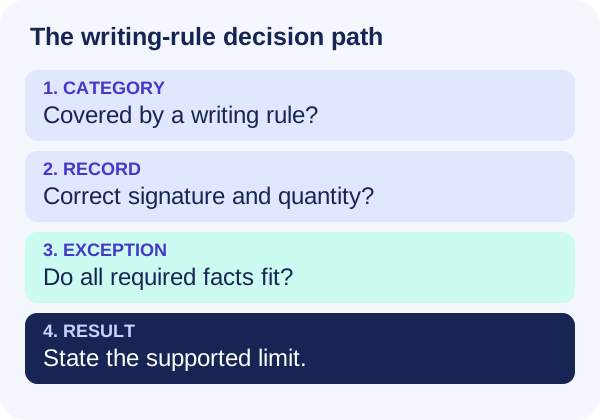
1. Screen the agreement for a writing requirement
Start with these six traditional study categories. State rules and exceptions differ; apply the law supplied in the question.
| Category | Trigger | Read carefully |
|---|---|---|
| Marriage consideration | Promise exchanged for marriage | Not mutual promises to marry |
| One-year rule | Cannot finish within one year by its terms | Count from making the agreement |
| Land | Sale of a real-property interest | Do not treat land as UCC goods |
| Executor | Personal promise to pay estate debts | Identify whose funds are promised |
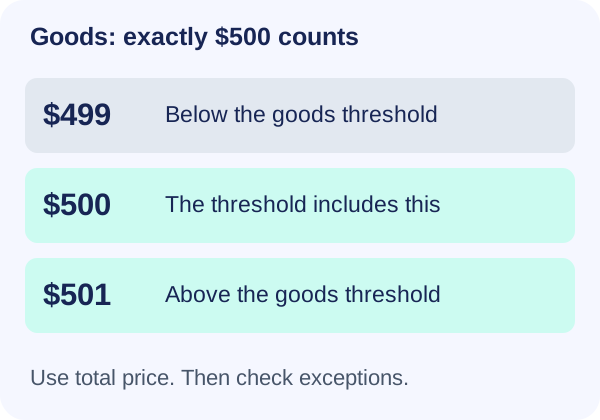
| Goods | Sale price of $500 or more | Use total price, not unit price |
| Surety | Promise to answer for another's debt | Check the supplied exceptions |
2. Worked example: compare price, signature, and quantity
Assume valid formation, nonmerchant parties and no exception. A buyer orally orders 40 tables at $30 each: $1,200 total. The seller signs a record indicating the sale but stating only 12 tables.
If the buyer seeks delivery from the seller, the seller is the party to be charged. That record supports at most 12 tables under the ordinary writing rule. A writing need not state every term, but its quantity limits enforcement.
Quick check: a goods order is 20 units at $25 each. Does the price reach the writing-rule threshold?
Check the threshold
Yes. 20 × $25 = $500, and the rule includes exactly $500. An applicable exception could still matter.
3. Check the UCC exception facts
Merchant confirmation: between merchants, a timely confirmation sufficient against its sender can satisfy the rule against its recipient. The recipient must have reason to know its contents and fail to object in writing within 10 days of receipt.
Custom goods: they must be unsuitable for ordinary resale, with a substantial manufacturing start or procurement commitments before notice of repudiation, under circumstances identifying this buyer.
Court admission: enforcement is limited to the quantity admitted. Accepted performance: the rule permits enforcement for goods received and accepted, or paid for with payment accepted.
These exceptions satisfy the writing rule; formation and other defenses remain separate.
4. Avoid three shortcuts
An oral agreement is not automatically unenforceable. First identify a covered category, then ask whether sufficient evidence or an exception exists.
For the one-year screen, measure from the agreement date and read its terms. A fixed 18-month service commitment falls within that screen even if work starts immediately.
A signature is not always required from both parties under the ordinary rule. Identify the party being sued. Keep land-specific exceptions separate from the UCC goods exceptions.
5. Try an original REG-style question
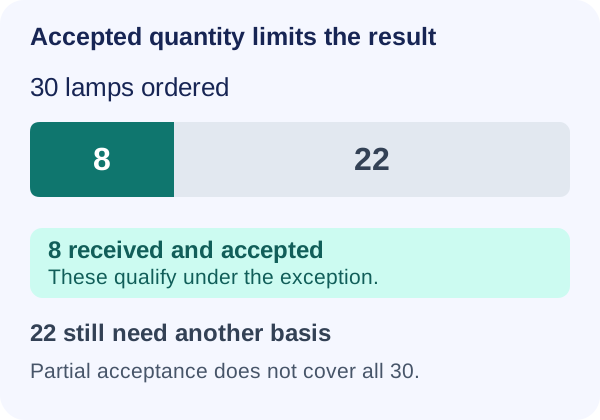
Nonmerchants orally agree on 30 lamps at $24 each. Valid formation is established. No signed record, payment, court admission or custom manufacture exists. The buyer receives and accepts 8 lamps. How many qualify under the accepted-goods exception?
- A. 0 lamps
- B. 8 lamps
- C. 30 lamps
- D. Only lamps already paid for
Reveal the answer and explanations
B is correct: 8 lamps. The $720 order reaches the threshold, but receipt and acceptance support those 8 only.
- A ignores the accepted-goods exception.
- C incorrectly extends acceptance to all 30.
- D wrongly requires payment as well as receipt and acceptance.
Check your reasoning
- Identify the covered category.
- Check signature, quantity and exception facts.
- State only the result those facts support.
Common statute of frauds questions
Is $500 per item or per contract?
The goods rule uses the contract price. Twenty items at $25 reach $500.
Does an unsigned confirmation always work?
No. The merchant rule has specific conditions; the confirmation must be sufficient against its sender.
Does partial acceptance cover every unit?
No. On the stated facts, only the received and accepted quantity qualifies.
Is this a rule for a real legal dispute?
No. Real disputes require jurisdiction-specific legal analysis; this lesson is exam education.
Related REG study
- Contract typesClassify promise, performance and restitution.
- REG study topicsChoose another REG topic.
- CPA Exam BlueprintsReview section scope and task statements.
Scope and sources
The January 2026 REG Blueprint covers contract formation and written/verbal contracts; this lesson is an educational inference. State statutes corroborate the stated rules, not uniform treatment of every dispute. Original CPAPass exercises imply neither AICPA authorship nor endorsement.