Equivalent Units for BAR: Weighted-Average Costing
The weighted-average method
Weighted-average equivalent units = completed units + ending work in process × its completion percentage. Calculate materials and conversion separately. Divide each category's beginning-plus-current costs by its equivalent units. Here: 12,000 materials EU and 10,200 conversion EU.
Sources checked . Original teaching exercises, not AICPA exam questions.
1. Reconcile physical units first
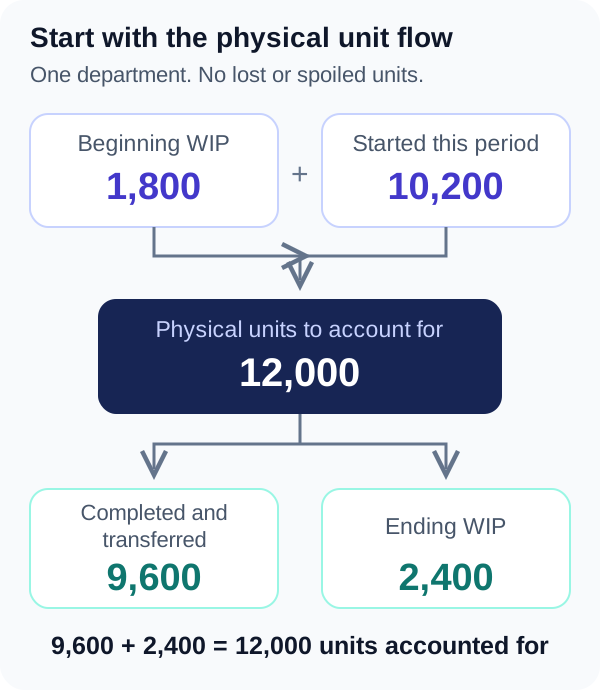
A mixing department uses weighted-average process costing. Beginning work in process (WIP) contains 1,800 units; another 10,200 units enter this period. The department transfers 9,600 completed units, leaving 2,400 unfinished.
Assume one initial department, no transferred-in costs, and no spoilage or losses. All materials enter at the start; conversion costs (labor and overhead) accrue uniformly. Ending WIP is 25% converted. Beginning WIP was 30% converted.
2. Build two equivalent-unit columns
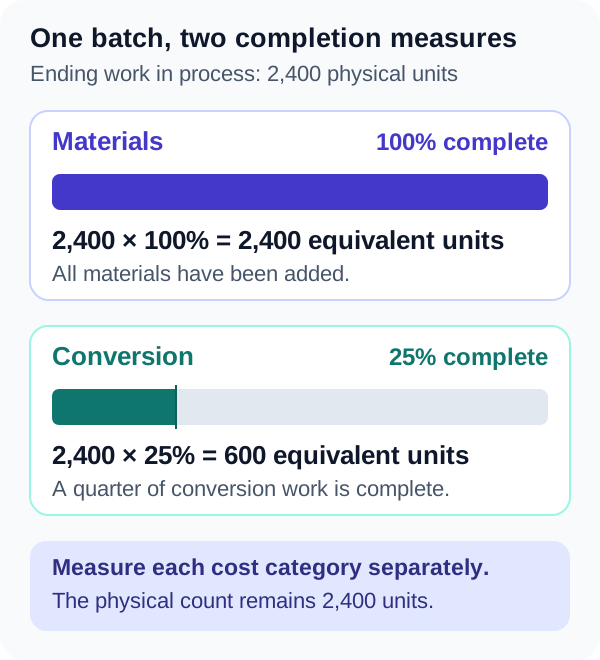
Transferred units are complete for both categories. Ending WIP has all its materials but only one-quarter of its conversion work.
| Output | Materials EU | Conversion EU |
|---|---|---|
| 9,600 transferred | 9,600 | 9,600 |
| 2,400 ending WIP | 2,400 × 100% = 2,400 | 2,400 × 25% = 600 |
| Total | 12,000 | 10,200 |
Do not add beginning WIP again: it is already included in the reconciled output. Its 30% opening conversion percentage is not subtracted under weighted average. That would mix methods.
Quick check: If ending conversion were 40% instead, how many conversion EU would the 2,400 unfinished units contribute?
Check the equivalent units
960 EU: 2,400 × 40%. This is the ending-WIP contribution, not total departmental EU.
3. Pool costs within each category
Weighted average combines beginning WIP costs with costs added this period. Keep each numerator paired with its own EU denominator.
| Cost calculation | Materials | Conversion |
|---|---|---|
| Beginning WIP | $6,000 | $4,500 |
| Added this period | $66,000 | $46,500 |
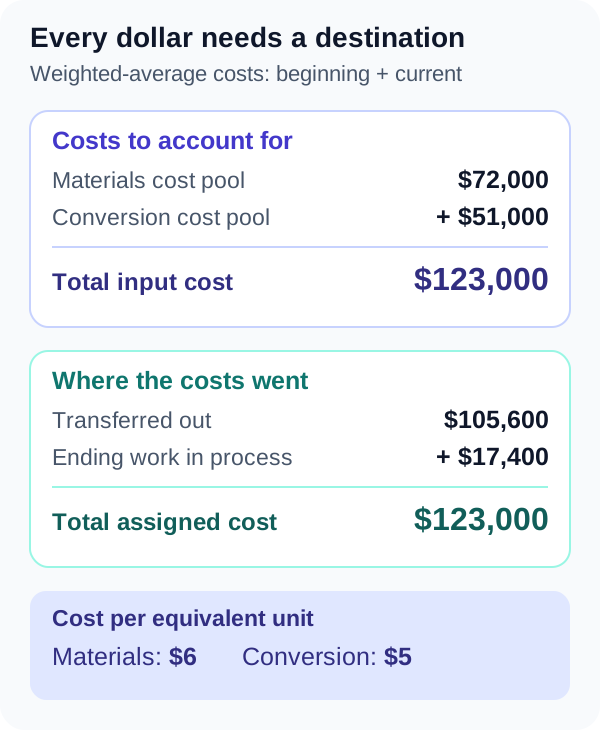
| Total to allocate | $72,000 | $51,000 |
| Divide by EU | 12,000 | 10,200 |
| Cost per EU | $6 | $5 |
The category totals include prior-period costs even though the opening completion percentage was unnecessary for the EU calculation. This is process-cost averaging, not inventory purchase-cost averaging.
4. Assign every dollar once
Transferred output receives both full category rates: 9,600 × ($6 + $5) = $105,600.
Ending WIP receives 2,400 materials EU × $6 + 600 conversion EU × $5 = $17,400. The physical units remain, carrying less conversion cost because they are unfinished.
| Check | Use | Avoid |
|---|---|---|
| Physical flow | 12,000 units on both sides. | Adding beginning WIP twice. |
| Equivalent units | Separate completion percentages. | Treating unfinished conversion as complete. |
| Category rate | Beginning plus current costs. | Omitting opening costs. |
| Assigned costs | $105,600 + $17,400 = $123,000. | Leaving costs unassigned. |
5. Try a fresh conversion-cost question
Another department requires weighted average. Beginning WIP is 1,200 units, 40% converted. It starts 6,800 units, transfers 6,500, and ends with 1,500 units, 60% converted. Assume no losses. Beginning conversion cost is $4,800; current conversion cost is $39,600.
What is conversion cost per EU, rounded to cents?
- A. $5.35
- B. $5.55
- C. $6.00
- D. $6.42
Reveal the answer and explanation
C. $6.00. Conversion EU = 6,500 + 1,500 × 60% = 7,400. Pooled conversion cost = $4,800 + $39,600 = $44,400. Divide $44,400 by 7,400.
A ($5.35) omits beginning costs: $39,600 ÷ 7,400. B ($5.55) uses physical units: $44,400 ÷ 8,000. D ($6.42) subtracts opening conversion work but retains pooled costs: $44,400 ÷ (7,400 - 1,200 × 40%).
Repeat the three checks
- Reconcile physical units.
- Calculate EU and cost per EU by category.
- Assign costs and reconcile the total.
Common equivalent-unit questions
Are equivalent units the physical unit count?
No. They measure completed work by cost category. Unfinished units remain physical units.
Why are materials 100% complete here?
The example adds all materials at the start. A different materials-entry point could change that percentage.
Does weighted average subtract opening completion?
No. It pools beginning and current costs and includes completed output in full.
What should the assigned costs total?
Transferred output plus ending WIP must equal the beginning-plus-current costs being allocated.
Related BAR study
- Joint cost allocationSplit a pool between joint products.
- Activity-based costingAssign costs using activity drivers.
- BAR section overviewPlan your broader section study.
Scope and sources
The 2026 AICPA Blueprint names process costing. Equivalent units and weighted average are not separately named; this BAR connection is an educational inference, not an exam-frequency claim.
ACCA and OpenStax support costing mechanics. Examples and diagrams are original.