Future Value of an Annuity: Follow the Deposits Forward
Quick answer
Future value of an ordinary annuity = payment × [(1 + r)^n - 1] ÷ r. It accumulates equal end-of-period deposits to time n, just after the final deposit. Here, four $2,400 deposits at 5% become $10,344.30.
Reviewed . Original CPAPass exercises.
1. Mark the date you are solving for
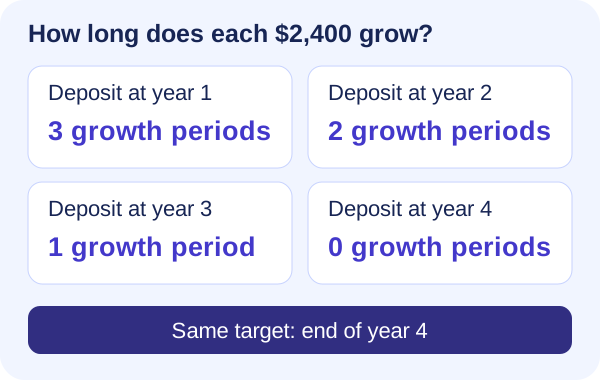
Write the target date first. Each deposit earns interest only from its own deposit date to that target.
Use a constant rate per payment period and count the deposits. A starting lump sum is separate; do not add it to every periodic payment.
2. Build the balance one year at a time
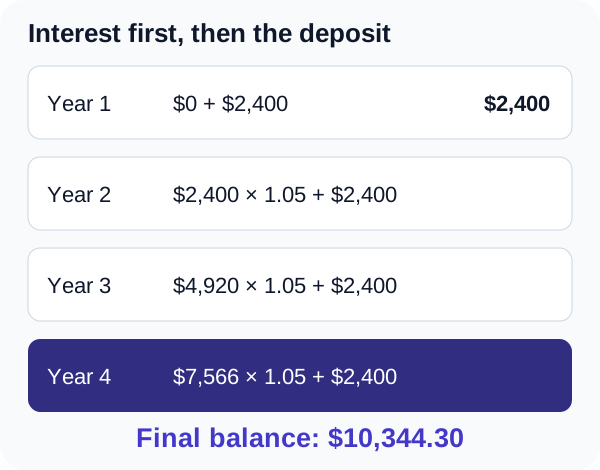
Cedar deposits $2,400 at each year-end for four years. The account earns a constant 5% effective annual rate. Find the balance immediately after deposit four. Assume no opening balance, withdrawals, taxes or fees.
| Year | Interest | After deposit |
|---|---|---|
| 1 | $0.00 | $2,400.00 |
| 2 | $120.00 | $4,920.00 |
| 3 | $246.00 | $7,566.00 |
| 4 | $378.30 | $10,344.30 |
Each year: opening balance × 1.05 + new deposit. The factor shortcut gives $2,400 × 4.310125 = $10,344.30, matching the roll-forward.
Quick check: Does deposit four earn one year of interest by the target date?
Check the last deposit
No. Deposit four arrives at the target date, so it contributes exactly $2,400. Deposit one earns three years of interest.
3. Separate deposits from earned interest
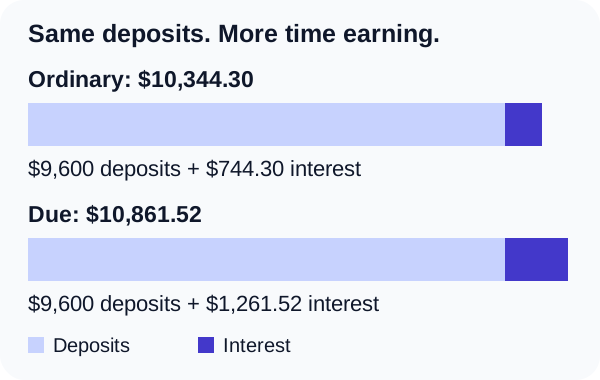
The company contributed $9,600. Subtract that from $10,344.30: accumulated interest is $744.30. Interest is only the increase above contributions.
If those same four deposits move to the beginning of each year, keep the target at year 4. Each deposit now earns one extra year: $10,344.30 × 1.05 = $10,861.515, or $10,861.52.
That annuity-due balance is $517.22 higher, after rounding. It still contains four deposits. The last deposit at time 3 earns interest until time 4.
4. Avoid three factor mistakes
Match units. Three years of quarterly deposits means 12 payments. Use the supplied quarterly rate; do not divide an effective annual rate by four without converting it.
Do not compound all deposits for n periods. Later deposits have less time. Unequal deposits or changing rates require separate calculations.
At a zero rate, future value equals payment × count. Otherwise, retain full precision and round the final currency amount to cents.
For value today, use the separate present-value lesson. This example does not choose investments or sell annuity products.
5. Try an original accumulation question
A company deposits $3,100 at the beginning of each year for three years, starting today. At a constant 4% effective annual rate, what is the balance at the end of year 3? Assume no other cash flows.
- A. $9,676.96
- B. $10,064.04
- C. $9,300.00
- D. $10,461.24
Reveal the answer and explanations
B is correct: $10,064.04. Add $3,100 × 1.04³, $3,100 × 1.04² and $3,100 × 1.04. Each deposit has its own compounding horizon.
- A uses year-end deposits, missing one interest period for each deposit.
- C reports only contributions and omits all interest.
- D compounds all $9,300 for three years, as if every deposit happened today.
Check your reasoning
- Mark every deposit and the target date.
- Count growth periods separately.
- Subtract contributions to isolate interest.
Common annuity questions
Is the final ordinary deposit multiplied by 1 + r?
No. At time n it has just arrived, so its growth factor is 1.
What if money is already in the account?
Compound that opening lump sum separately, then add the future value of the deposits.
Does a due factor need another timing adjustment?
No. If your supplied factor already is for an annuity due, multiply it only by the payment.
Are these returns predictions?
No. Rates and deposits are fixed assumptions for an accounting exercise.
Related BAR study
- Present value of an annuityValue the stream today instead.
- Capital budgetingAssess project cash flows and investment decisions.
- BAR study topicsChoose your next BAR topic.
Scope and sources
The January 2026 Blueprint covers BAR financial valuation models. This future-value annuity connection is an educational inference, not a named task. OpenStax supports the mechanics. Reviewed September 30, 2026. Original CPAPass examples and diagrams; not AICPA material.