Closing Entries: Reset Temporary Accounts and Prove Retained Earnings
Quick answer
Closing entries reset temporary accounts to zero. With Income Summary, close revenues, close expenses, transfer net income or loss to Retained Earnings, then close Dividends separately.
Reviewed . Original CPAPass exercises.
1. Choose the accounts to close
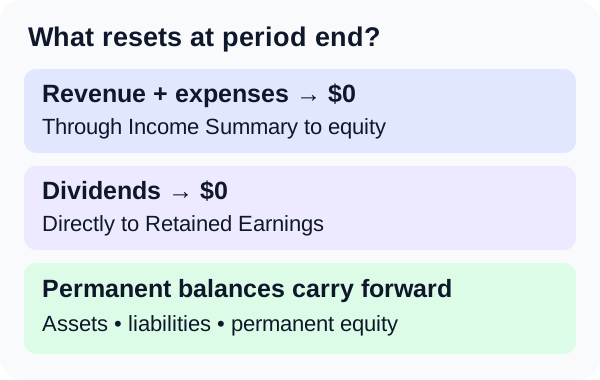
Start with adjusted balances. Revenues, expenses and the temporary Dividends account reset; assets, liabilities and permanent equity accounts carry forward.
Our corporation uses Income Summary and a separate Dividends account. All expenses are supplied; assume no other equity changes or OCI.
2. Worked example: post the four entries
Cedar Studio has $96,500 service revenue, $38,200 salaries expense, $14,400 rent expense, $5,200 depreciation expense and $8,400 dividends. Beginning Retained Earnings is $41,800.
| Close | Debit | Credit |
|---|---|---|
| Revenue | Service Revenue $96,500 | Income Summary $96,500 |
| Expenses | Income Summary $57,800 | Salaries Expense $38,200; Rent Expense $14,400; Depreciation Expense $5,200 |
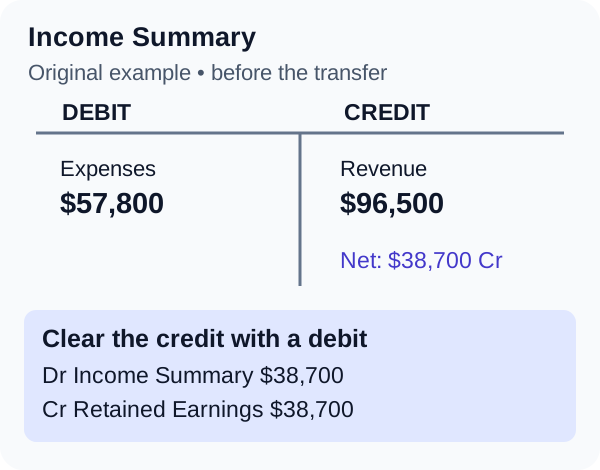
| Net income | Income Summary $38,700 | Retained Earnings $38,700 |
| Dividends | Retained Earnings $8,400 | Dividends $8,400 |
Expenses total $57,800; net income is $38,700. Each table row is one balanced entry. Close the actual expense accounts, not an invented total-expense account.
Quick check: After the first two entries, Income Summary has a $38,700 credit balance. Which side clears it?
Check the closing direction
Debit Income Summary $38,700 and credit Retained Earnings $38,700. A debit cancels the credit balance.
3. Reconcile the ending balances
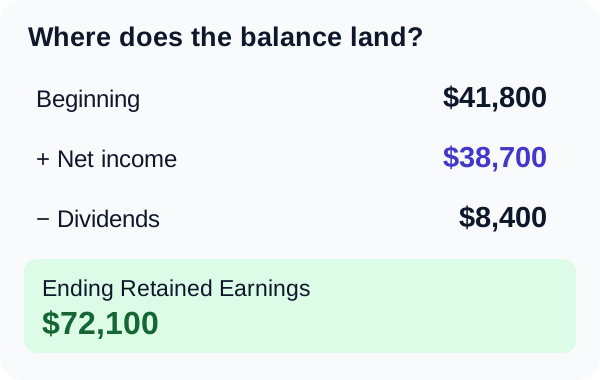
Ending Retained Earnings = $41,800 + $38,700 - $8,400 = $72,100. The $30,300 increase is income less dividends.
| Account | Before closing | After closing |
|---|---|---|
| Service Revenue | $96,500 credit | $0 |
| Expense accounts combined | $57,800 debit | $0 |
| Dividends | $8,400 debit | $0 |
| Retained Earnings | $41,800 credit | $72,100 credit |
After posting, Revenue, each Expense, Income Summary and Dividends are zero. Retained Earnings carries $72,100 into the next period.
Check the $38,700 transfer against the income statement before posting. A correct debit-credit total alone cannot detect a dividend incorrectly classified as an expense.
Closing transfers already-recorded results; it does not create another sale or pay another dividend. Cash stays unchanged by these four entries.
4. Avoid three closing traps
Do not close Accumulated Depreciation or Dividends Payable. They are permanent accounts, unlike Depreciation Expense and the temporary Dividends account.
For a net loss, reverse the profit transfer: debit Retained Earnings and credit Income Summary. Keep dividends outside net income.
Income Summary is an intermediary, not a required software account. Direct closing can reach the same result. Adjusting and optional reversing entries serve different purposes.
5. Try an original loss question
A corporation has $64,000 revenue, $71,500 expenses, $2,200 dividends and $29,000 beginning Retained Earnings. Revenues and expenses are already closed. Which entry closes Income Summary?
- A. Debit Income Summary $7,500; credit Retained Earnings $7,500.
- B. Debit Retained Earnings $7,500; credit Income Summary $7,500.
- C. Debit Retained Earnings $9,700; credit Income Summary $9,700.
- D. Debit Retained Earnings $71,500; credit Income Summary $71,500.
Reveal the answer and explanations
B is correct. The $7,500 net loss leaves a debit in Income Summary; credit it to zero and debit Retained Earnings. After the separate dividend close, Retained Earnings is $19,300.
- A treats the loss as income and increases equity.
- C includes $2,200 dividends in the loss transfer, although they close separately.
- D uses $71,500 total expenses instead of the $7,500 net loss.
Check your reasoning
- Identify temporary accounts.
- Clear each balance with the opposite side.
- Reconcile beginning equity, income or loss, and dividends.
Common closing-entry questions
Do I close Cash?
No. Cash is a permanent asset account. These closing entries do not move cash.
Are dividends an expense?
No. In this example, the temporary Dividends account closes directly to Retained Earnings.
Does Income Summary carry forward?
No. Its balance becomes zero when net income or loss transfers to Retained Earnings.
Must every system use Income Summary?
No. A system can close directly to Retained Earnings. The intermediary makes the income reconciliation visible.
Related FAR study
- Trial balance stagesIdentify the balances supplied before closing.
- Reversing entriesHandle optional next-period reversals.
- FAR study topicsChoose your next FAR topic.
Scope and sources
The FAR connection is an educational inference from financial-reporting tasks in the January 2026 Blueprint. OpenStax (2019) supports the mechanics. Reviewed September 28, 2026. Examples, diagrams and questions are original CPAPass work, not AICPA material.