LIFO Liquidation: Trace the Older Costs into Profit
Quick answer
LIFO liquidation occurs when cost allocation reaches inventory layers carried from earlier periods. When those older costs are lower than current costs, COGS falls and gross profit rises relative to using current costs for the same sales.
Reviewed . Original CPAPass exercises.
1. Identify the older layer being used
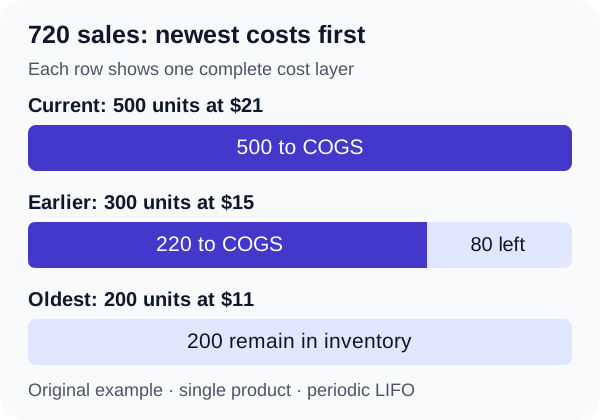
For one unchanged product under periodic LIFO, selling more units than the period adds draws down beginning layers. Use the newest available costs first, then work backward.
This is a cost-flow assumption, not a claim about which physical items leave the warehouse. Dollar-value pools and price indexes require a different calculation.
2. Work an original layer example
Aster sells 720 identical brackets for $34 each. Beginning layers are 200 units at $11 and 300 at $15; current purchases add 500 at $21. Assume periodic LIFO, rising costs, and no returns, write-downs or taxes.
| Layer | COGS | Ending inventory |
|---|---|---|
| 500 at $21 | $10,500 | $0 |
| 300 at $15 | $3,300 | $1,200 |
| 200 at $11 | $0 | $2,200 |
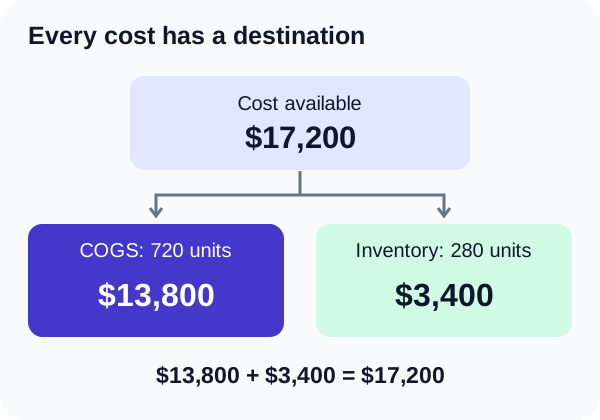
| Total | $13,800 | $3,400 |
COGS = (500 × $21) + (220 × $15) = $13,800. Ending inventory = (80 × $15) + (200 × $11) = $3,400. Together they reconcile to the $17,200 cost available.
Quick check: if Aster sold 560 units instead, which beginning layer would enter COGS?
Check the older layer
60 units from the $15 layer. The $11 layer remains untouched.
3. Separate the cost effect from better sales
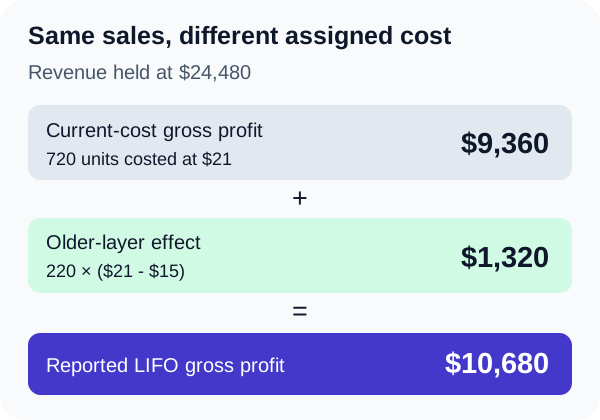
Revenue is 720 × $34 = $24,480. Reported gross profit is $24,480 - $13,800 = $10,680.
Use $21 per unit as the stated current-cost benchmark. COGS at that benchmark would be $15,120, giving $9,360 gross profit. The $1,320 difference equals 220 × ($21 - $15).
That difference isolates the older-cost effect with revenue held constant. It is neither extra cash nor proof of stronger operations, and it is not a FIFO comparison.
4. Check the assumptions and disclosure scope
A quantity reduction and a price decline are different facts. If the older costs exceed current costs, using those layers can reduce profit relative to current costs. Calculate the difference rather than assuming a gain.
SEC Topic 11.F requires disclosure when a registrant’s substantial LIFO liquidation creates material income. The effect may appear in a footnote or parenthetically on the income statement. This is a registrant-specific disclosure rule, not a universal materiality cutoff.
5. Try a two-layer liquidation question
Beginning layers, oldest first, are 120 units at $17 and 180 at $20. Current purchases are 450 at $26. Under the same assumptions, 720 units sell. Compared with costing all sales at $26, how does liquidation affect pretax profit?
- A. $1,080 increase
- B. $1,890 increase
- C. $1,620 increase
- D. $2,430 increase
Reveal the answer and explanations
B is correct: $1,890 higher. Use 180 × ($26 - $20) + 90 × ($26 - $17). COGS is $16,830 versus the $18,720 benchmark.
- A counts only the $20 layer.
- C prices all 270 older units at $20.
- D prices all 270 older units at $17.
Check your reasoning
- Trace units newest first.
- Reconcile costs sold and retained.
- State the profit comparison benchmark.
Common LIFO liquidation questions
Does liquidation always increase profit?
No. The direction depends on older versus current costs.
Is the profit effect additional revenue?
No. Here revenue stays fixed; the cost assigned changes.
Which older layer is used first?
The most recent remaining layer, before earlier layers.
Is this a dollar-value LIFO calculation?
No. This exercise tracks one product in physical units.
Related FAR study
- LIFO versus FIFOCompare the cost-flow methods.
- Weighted-average inventoryReview a different costing method.
- FAR study topicsChoose another FAR topic.
Scope and sources
The January 2026 FAR Blueprint covers inventory costing; this liquidation application is an educational inference. OpenStax supports cost flow, and SEC Topic 11.F supports the registrant disclosure note. Original CPAPass exercises imply no exam frequency, AICPA authorship or endorsement.