Cost of Goods Manufactured: Build the BAR Schedule
Quick answer
Cost of goods manufactured (COGM) is the cost of production completed during a period. Formula: beginning work in process (WIP) + direct materials used + direct labor + applied manufacturing overhead - ending WIP.
Reviewed . Original CPAPass exercises.
1. Find direct materials used
Cedar Manufacturing supplies these materials amounts for one period:
| Materials input | Amount |
|---|---|
| Beginning raw materials | $18,200 |
| Net material purchases | $97,400 |
| Ending raw materials | $21,600 |
| Indirect materials issued | $6,000 |
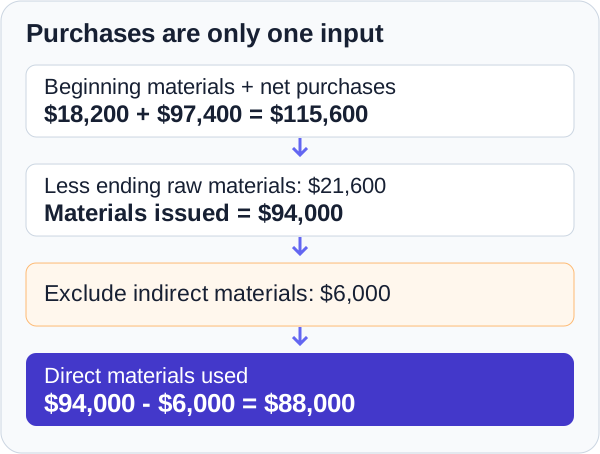
Purchases are not materials used. Reconcile raw materials first, then remove indirect materials issued. Those costs belong to overhead, not direct materials.
In this worked example, raw materials available total $115,600. Of that total, $21,600 stayed unused and $94,000 was issued. Removing the indirect portion leaves $88,000 traceable to production as direct materials.
Assume net purchases are given, overhead is already applied, and there are no abnormal spoilage or overhead-variance adjustments. Take WIP dollar balances as given.
2. Complete the cost of goods manufactured schedule
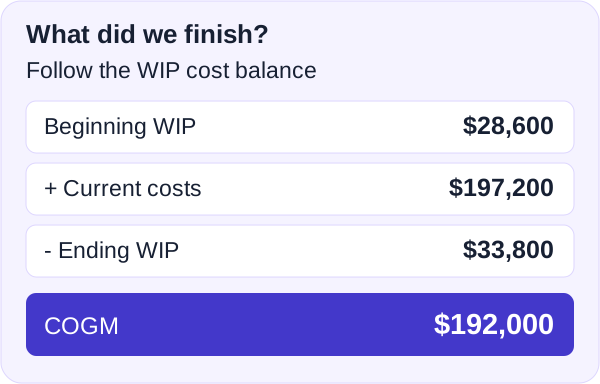
Add current production costs, then reconcile WIP. Beginning WIP brings prior-period unfinished cost forward; ending WIP removes cost still unfinished.
| Schedule line | Amount |
|---|---|
| Direct materials used | $88,000 |
| Add direct labor | $62,400 |
| Add applied overhead | $46,800 |
| Current manufacturing costs | $197,200 |
| Add beginning WIP | $28,600 |
| Less ending WIP | ($33,800) |
| Cost of goods manufactured | $192,000 |
Quick check: Keep every input except ending WIP, which rises to $39,800. What is COGM?
Check the completed cost
$186,000: $28,600 + $197,200 - $39,800. An extra $6,000 remains unfinished, so completed cost falls by $6,000.
3. Transfer the completed cost
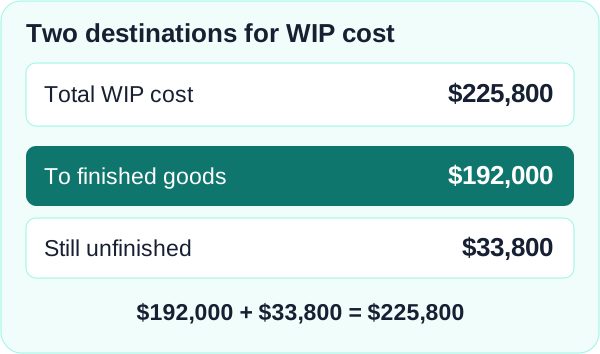
Move the $192,000 completed cost out of WIP and into finished goods:
| Account | Debit | Credit |
|---|---|---|
| Finished Goods Inventory | $192,000 | - |
| Work in Process Inventory | - | $192,000 |
This records completion, not a sale. Finished goods may remain unsold; COGM is not automatically cost of goods sold.
Use a reverse calculation as a control: completed cost plus ending WIP must equal beginning WIP plus current costs. Here both sides are $225,800. A mismatch means a cost was omitted, duplicated, or assigned to the wrong period.
4. Catch the three common mix-ups
Do not use $97,400 purchases as direct materials. Do not add the $6,000 indirect materials again: overhead is already applied. Do not stop at $197,200 current costs: the WIP adjustment changes the completed amount.
Check the labels before subtracting: ending raw materials affects materials issued, while ending WIP affects completed production. They are separate inventory balances.
5. Try an original BAR-style question
Use the same assumptions with this new period. Indirect materials belong to overhead; the overhead amount below is already applied. What is COGM?
| Given amount | Cost |
|---|---|
| Beginning raw materials | $12,800 |
| Net material purchases | $76,200 |
| Ending raw materials | $15,400 |
| Indirect materials issued | $3,600 |
| Direct labor | $48,000 |
| Applied overhead | $36,000 |
| Beginning WIP | $22,400 |
| Ending WIP | $18,400 |
- A. $154,000
- B. $158,000
- C. $161,600
- D. $150,000
Reveal the answer and explanations
B. $158,000. Direct materials = $12,800 + $76,200 - $15,400 - $3,600 = $70,000. Current costs = $70,000 + $48,000 + $36,000 = $154,000. COGM = $22,400 + $154,000 - $18,400.
- A ignores the WIP adjustment. It reports only the current manufacturing costs added.
- C counts indirect materials twice. Direct materials should exclude the $3,600 overhead input.
- D subtracts beginning WIP and adds ending WIP. That incorrectly reduces completed cost when unfinished inventory has fallen.
Check your method
- Separate direct from indirect materials.
- Add labor and applied overhead.
- Add beginning WIP; subtract ending WIP.
Common manufacturing-cost questions
What does a COGM schedule show?
It reconciles production costs to the cost completed during the period. The worked schedule produces $192,000.
Why subtract ending WIP?
Those goods are unfinished. Their cost stays in WIP rather than transferring to finished goods.
Where do indirect materials go?
Through manufacturing overhead. Exclude them from direct materials used and do not add them again to supplied applied overhead.
Is COGM the same as cost of goods sold?
No. COGM concerns completed production; cost of goods sold concerns products sold.
Related BAR study
- Predetermined overhead rateSee how overhead is assigned.
- Weighted-average equivalent unitsStudy partially completed production.
- BAR study topicsPlan your wider BAR study.
Scope and sources
The 2026 BAR7 blueprint names job-order and process costing, not COGM separately. The BAR connection is an educational inference, not an exam-frequency claim. OpenStax was published February 14, 2019; sources were reviewed September 15, 2026. Exercises are original, not AICPA questions.