Normal vs Abnormal Spoilage: Inventory or Expense?
Quick answer
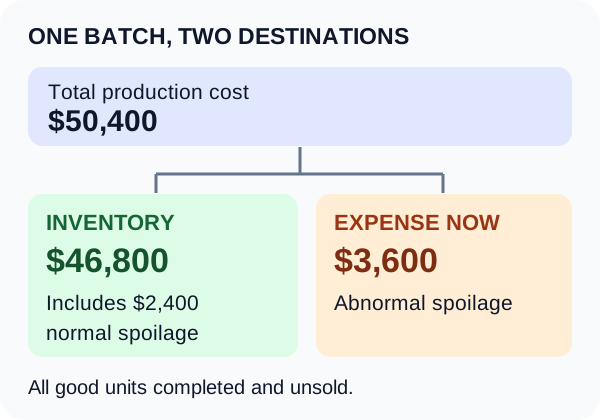
Normal spoilage is an inherent production cost carried by the good output. Abnormal spoilage is charged to expense in the current period instead of being included in inventory. Classify the cost first; then calculate the inventory amount.
Reviewed . Original CPAPass exercises.
1. Classify the waste before calculating
Normal does not mean desirable. It means the loss belongs to the ordinary production process. Abnormal waste falls outside that process; repeated avoidable failures do not become normal merely because they recur.
Use the facts supplied, not a universal percentage cutoff. This lesson takes the normal and abnormal classifications and their assigned costs as given.
2. Work an original batch example
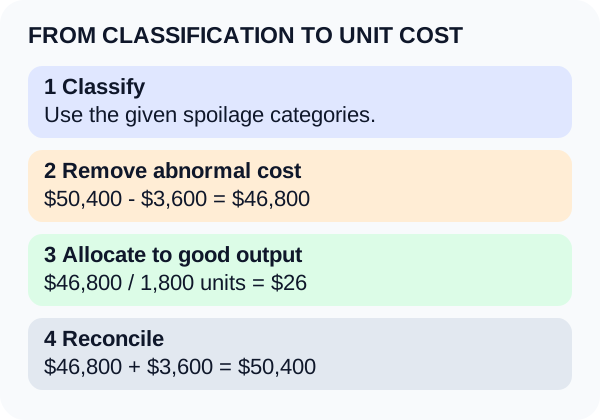
Mica makes ceramic insulators. Total batch cost is $50,400, including $2,400 of normal spoilage and $3,600 of abnormal spoilage. All 1,800 good units are completed and unsold. Assume no beginning or ending WIP, salvage, overhead variances or taxes.
| Cost | Amount | Destination |
|---|---|---|
| Total incurred | $50,400 | Both categories included |
| Normal spoilage | $2,400 | Stays within inventory |
| Abnormal spoilage | $3,600 | Current-period loss |
| Good output | $46,800 | Finished goods |
Keep the normal cost inside the batch. Remove only the abnormal cost: $50,400 - $3,600 = $46,800 of finished goods. Cost per good unit is $46,800 / 1,800 = $26.
Quick check: total cost is $12,600, including $900 normal and $600 abnormal spoilage. Under the same assumptions, what remains in inventory?
Check the inventory amount
$12,000 remains: $12,600 - $600. The $900 normal cost is already included; do not add it again.
3. Trace the costs into the accounts
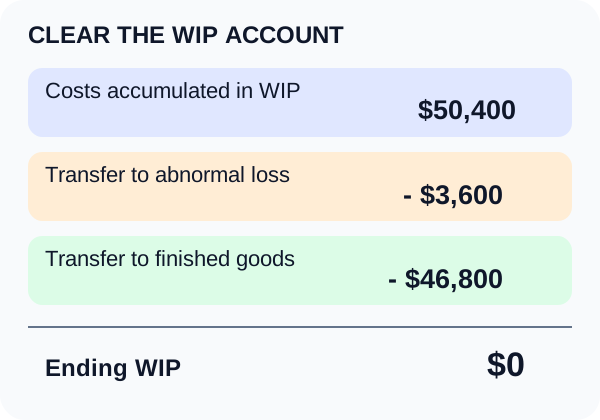
If all $50,400 was first accumulated in WIP, debit Loss from Abnormal Spoilage and credit WIP $3,600. Then debit Finished Goods and credit WIP $46,800 for the completed good units.
WIP clears: $50,400 - $3,600 - $46,800 = $0. The loss is immediate even though none of the good units has sold.
The $46,800 stays in finished goods until sale, absent other valuation adjustments. As good units sell, their cost moves to COGS. Normal spoilage therefore affects expense through the good units, not a second spoilage loss.
4. Avoid three cost traps
Do not expense both categories. Removing the $2,400 normal cost as well would understate this batch inventory by $2,400.
Do not divide inventory cost by defective units plus good units. Here the denominator is the 1,800 good units carrying that cost.
Do not apply this shortcut to unfinished production. Inspection timing, equivalent units, salvage and rework can change a fuller cost allocation. This example starts after spoilage costs have been assigned.
5. Try an original BAR-style question
Under the same assumptions, a completed batch costs $37,800, including $1,800 normal and $3,000 abnormal spoilage. All 1,200 good units remain unsold. What inventory and immediate loss should be recorded?
- A. $37,800 inventory; $0 loss
- B. $34,800 inventory; $3,000 loss
- C. $33,000 inventory; $4,800 loss
- D. $36,000 inventory; $1,800 loss
Reveal the answer and explanations
B is correct: $34,800 inventory and $3,000 loss. Subtract abnormal cost only; each good unit carries $29.
- A capitalizes abnormal waste and omits the loss.
- C expenses normal spoilage too, understating inventory.
- D reverses the two classifications.
Check your reasoning
- Identify what total cost already includes.
- Remove abnormal cost once.
- Reconcile inventory plus the loss.
Common spoilage questions
Is normal spoilage free?
No. Its cost is carried by the good output.
Must abnormal spoilage wait for a sale?
No. Recognize its cost as a current-period expense.
Should I add normal cost to the given total?
Not when the total already includes it, as here.
Does this calculate a spoilage rate?
No. Classification and assigned costs are given; this lesson separates their accounting effects.
Related BAR study
- Cost of goods manufacturedReview the production-cost schedule.
- Equivalent unitsStudy a no-spoilage WIP example.
- BAR study topicsChoose another BAR topic.
Scope and sources
The January 2026 BAR Blueprint covers costing methods; this spoilage lesson is an educational inference. FAS151 provides the historical abnormal-cost rule, cross-checked against the October 2025 KPMG Inventory Handbook. OpenStax explains inventory cost flow. Original exercises imply no exam frequency, AICPA authorship or endorsement.